
First Lynncote

As important for landscape design as for its progressive architecture of 1892, this estate was of national significance, and at Lynncote are seen the Arts & Crafts motifs adapted for Appalachian mountains that would define Tryon for a generation.
Charles Erskine purchased a knoll overlooking Pacolet Valley after bringing his family from Wisconsin for two winters at nearby McAboy’s Hotel. Keenly interested in the latest design trends, he retained Richard Sharp Smith, young British-born architect who designed the pebble-dash structures of Biltmore Village in Asheville for Vanderbilt. Lynncote’s architecture is far more avant-garde, however, in the rustication of its stonework and strong horizontal lines, and is less antiquarian English in manner. The interior was aggressively plain, and featured such innovations as Native American weavings used for portieres.

Lynncote, its outbuildings and its landscape features, carefully wrought to appear ruggedly primeval, show the emerging sharp break with the Victorian and the influence of the new Prairie School in the Midwest. This architecture was so advanced that truly compatible furnishings were not yet available in the “Mission” style. The Erskines’ son Ralph later became a designer of furniture,and published a seminal 1907 article on handicrafts of the Southern highlands for Gustav Stickley’s The Craftsman magazine.
A separate studio building nearby in the forest was designed for Erskine’s highly-creative wife Emma, author who published under the pen name Payne Erskine and daughter of a British-born Chicago artist. Charles E. Erskine’s design for his wife’s wooden Arts & Crafts outbuilding was even more radically modern and simple, with a hipped roof of slight pitch and simple fenestration. The Studio burned down in 1920 during the residency of artist Roy Elliott Bates.

A 1916 fire gutted the interior and completely destroyed the upper stories of the first Lynncote. With Charles Erskine dead since 1908, his widow Emma did not rebuild. Its massive stone walls remained a picturesque ruin until her daughter Susan and her husband Carroll Pickens Rogers decided to build anew in 1927, retaining Cornell-trained Erle Gulick Stillwell as architect. He utilized creatively Smith’s earlier stone walls and porte-cochere to create a unique second Lynncote. Out of the old Arts & Crafts ruin arose a fine new “Tudor” residence of the prosperous Twenties, now listed on the National Register of Historic Places.

Postcard with image by Tryon photographer W.B. Kruse mailed in 1909. Lynncote’s early landscape featured picturesque pergolas, railings, outdoor furnishings and this lake pavilion all fabricated from branches of rhododendron.

Charles Erskine’s workshop (extant) clad with horizontal weatherboarding also used for other outbuildings. Artistic chimney has exaggerated batter shape; dressed stone surmounts its rusticated base.
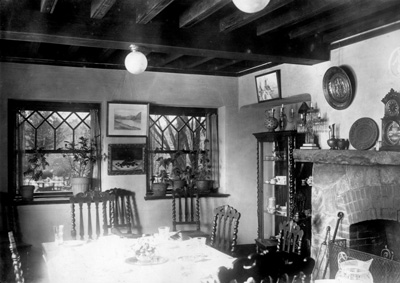
Dining room with undecorated wall surfaces and rustic fireplace.
Photographs courtesy of the Haynes family.
