
The House at Braewick Estates

Front view of house discloses its unmistakably Searlesian lineage. Large oaks, aucubas, camellias, boxwoods, and hollies surround in profusion, but the crowning touch consists of over 100 azaleas in nine different colors.
Tucked away in a sylvan enclave known today as Braewick Estates and surrounded by azaleas, aucuba, and a discretely designed and placed ring of condominiums, the two-and-a-half story 1926 cottage-inspired manse is visible only in a brief glimpse from Melrose Avenue. Originally the mini-estate’s sole occupant, the house was saved from possible destruction by an imaginative 1980s redevelopment plan. It stands today as a testament to sensitive historic preservation.

Eastward view from the terrace reveals wisteria vines in their winter dress contrasted with the year-round verdancy of the shrubbery. In summer, the vines provide an equally verdant canopy.
The history of the house is a microcosm of Tryon’s architectural and social history between the two World Wars—a tapestry that weaves together the legacies of an architect born to East Coast wealth who fulfilled his destiny in Tryon, a pioneer fighter for child welfare, human rights, and world peace, and a soft drink executive who helped build the fortunes of Pepsi Cola. Peripheral characters include the head of the 1880s and ‘90s Sugar Trust, a future Chief Justice of the United States, a future president of General Motors Corporation, and the founder of America’s first settlement house.

No architectural plans for the house are known to exist, but its link to J. Foster Searles is vouchsafed to anyone who happens to open a cabinet door in the linen closet.
Architect J. Foster Searles (1872-1949) was the son of John Ennis Searles, chief executive officer of the American Sugar Refining Company (aka “Sugar Trust”), a combine that at one time controlled 98 percent of the nation’s sugar production. A graduate of Wesleyan College, Searles’ early career included management roles in his father’s business interests. What attracted him to architecture is unknown, but his inborn talent was to become obvious. Reaching maturity in an era when formal architectural education was a new concept, he probably learned the intricacies of the craft working for an established architectural firm, perhaps in Boston.
In 1901, John Searles’ fortunes collapsed, most likely from speculative ventures outside the sugar industry. He declared bankruptcy (a move felt on Wall Street) but was shepherded through the process in months by his able attorney, Charles Evans Hughes, soon to be governor of New York, and subsequently a Presidential candidate, Secretary of State, and Supreme Court Chief Justice. Within another year Searles was once again adjudged a millionaire and was invested in cotton warehousing, railroads, mining, and the Hyatt Roller Bearing Company, a prospective player in the nascent auto industry. In 1905, he sold his majority stake in Hyatt to a group that included Alfred P. Sloan, who merged the concern with General Motors in 1916 and became GM’s president in 1923.
At some point in this period of his father’s undulating business fortunes, Foster Searles headed south. We know from his father’s 1908 obituary that he was, by that time, established in Tryon.

It’s said that every Searles-designed house has a unique stair railing design. Back staircase is enclosed and strictly functional, as are stairways to third floor and basement.
Over the next quarter century, Searles became the town’s most prolific architect or, at the least, its most enduring. In addition to multiple single-family dwellings, at least 15 to 20 of which survive, he designed the original St. Luke’s Hospital, the Lake Lanier Tea House, the Spanish Court Apartments, and the Tryon Toy Maker’s House, along with a redesign of Holy Cross Episcopal Church, where he was an active layman. The church as it stood in the 1920s was augmented in 1953 by a new and much larger sanctuary and now serves as the church’s chapel. A decorative Searles-designed wall niche, which may have been crafted by the Tryon Toy Makers, contains memorial inscriptions to Searles and his wife, Blanche, who died in 1925, and can be seen in the Chapel today. Searles left Tryon in 1933 to spend his retirement years in the Seychelles Islands but returned for a final visit in 1947.
Connecticut-born Edward Wheeler Frost (1859-1945) graduated from Harvard in 1884 and was admitted to the Wisconsin bar in 1886, the same year he married Ida Canfield (1860-1944). It appears that at some point, the Frosts became friends with Jane Addams, longtime advocate for the welfare of children and founder, in 1889, of Chicago’s groundbreaking Hull House. Frost became heavily involved in the fight against child labor and the drafting of legislation that protected children from that practice. At about the same time, he became an early member of the National Urban League and vice-president of its Milwaukee chapter.

Dining room has plaster walls with extensive wood trim. Each fireplace in house displays a unique identity.
The other compelling interest of Frost’s life and career—one also shared with Addams—was the cause of world peace. In the aftermath of World War I, he became an executive committee member of the League to Enforce Peace. In the 1920s, he attended conferences of the League of Nations and other international organizations in Warsaw, Berlin, and Geneva, among other cities. In Tryon, he gave talks on his international travels at the Lanier Library.
Mr. and Mrs. Frost spent time in Tryon at least as early as 1916. In the Polk County News account of the fire at the Mimosa Inn that year, the Frosts were listed among the Inn’s registered guests. A 1920 issue of the Harvard Alumni Bulletin lists a Tryon address for the Frosts. This was most likely a property the couple rented, a practice common among wealthy out-of-staters at the time. Then in 1922, the Frosts bought property at the entrance of the newly developing Gillette Woods from William Gillette himself. Four years later, they were comfortably settled in the residence that stands today, though they continued to maintain a home in Milwaukee and an apartment in Washington, D.C.

Pedestal bathtub in servant’s bath is one of a few original bathroom fixtures remaining.
The 1926 house contains nine rooms, including a servant’s wing with bath—this in addition to four other original bathrooms in the house. There is a full basement, as well as an 1100-square foot terrace, partly covered by a wisteria-enshrouded pergola. In typical Searles fashion, the exterior is asymmetrical with a small covered front porch, stucco finished walls, sharply gabled roof, prominent second floor dormers, and imposing brick and stone chimneys.

Living room offers space for built-in bookcases, travel and equine portraiture, and comfortable furniture that doubles as a secure canine refuge.
The interior exudes a casual warmth, devoid of excessive ornamentation but with occasional elegant touches, again a scheme emblematic of Searles. The walnut paneled living room displays exposed wooden ceiling beams, built-in glass-enclosed bookcases, a tiled-hearth fireplace with tile surround enclosed in wooden trim and topped by a decorative wooden mantelpiece, plus a bay window with plantation shutters. The dining room features a tiled fireplace offset from a wooden mantel, thick picture railings, a brass chandelier, and French doors opening to the sunroom. A master suite with fireplace, dressing room, and two baths covers the majority of the second floor.

Tiled and paneled living room fireplace wall provides a display case for original portrait of two beloved family horses.
Ida and Edward Frost died within a year of each other in the closing months of World War II and were buried in Tryon Cemetery. They left no children but had spent a good part of their lives vitally concerned with the welfare of others’ children. That doubtless is their most enduring legacy.
In 1946, the house was purchased by Mr. and Mrs. Thomas P. Hartness of Spartanburg. Once again, it would serve as a second home. Hartness was an Orange Crush and Pepsi Cola bottler who made Pepsi South Carolina’s best-selling soft drink. He was the uncle of Thomas S. Hartness who became the Greenville Pepsi Cola bottler in 1940 and, over the next 70 years, built his company into a worldwide total packaging solution provider, holding over 100 patents.
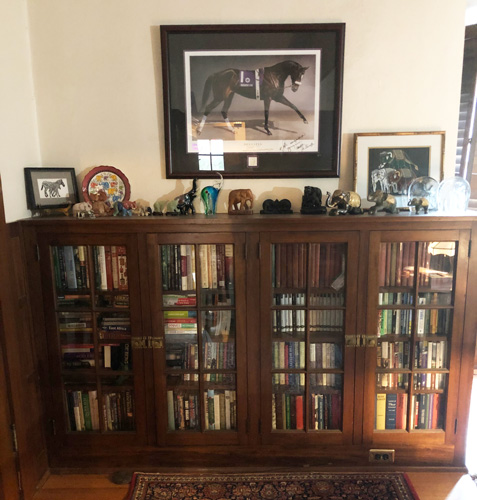
Head-on view of Searles-designed glass-front bookcase housing part of owner Fran Callaway’s equine literature collection, plus an array of miniature elephants accumulated during Asian and African travels.
Tom and Jo Hartness were, like the Frosts, childless but, in a similar spirit, devoted much of their time and treasure to the well-being of children, becoming major benefactors of the Presbyterian children’s home in Clinton, South Carolina, the Thornwell Home for Children.
Upon Mrs. Hartness’ death in 1970, the home was bequeathed to a relative, Estelle Willis, who it appears did not make use of it as a fulltime residence. In 1982, following the death of Ms. Willis, it was purchased from her estate by a development group from Winston-Salem.

A westward view from the spacious rear terrace affords a glimpse of some of the accompanying 1983 condominiums.
A transformation then took place, one that gave the property a new life but one completely consistent with its original ambience and niche in Tryon’s residential fabric. In 1983, Braewick Estates opened, featuring 13 condominiums with the Frost-Hartness house as centerpiece. It stands today as a living witness to the wisdom of adaptive reuse.

First, second, and third floor floor plans, as drawn by architectural draftsman Shannon Sweatman, owner of the house in the early 2000s.
It was love at first sight when present owners Fran and Dick Callaway discovered the house in 2014. They felt as though it had been designed with them in mind some 90 years earlier!
