
Lake Lanier: 1920s Civic Planning
An ambitious vision to create a pretty lake by damming Vaughn Creek, surrounded by new residential neighborhoods, came about as Tryon boomed after World War I. The project was conceived as a big, well-planned modern civic development just across the nearby state line, in South Carolina. Access was from the new paved highway, now US Highway 176, leading from Landrum S.C. into South Trade Street which parallels the Southern Railway from Spartanburg. An elegant hotel oriented southwest was planned, to overlook the development and the lake, with its own entrance at Jervey Road between the lake entrance and the Town’s commercial center. A plat of the project as originally conceived in the Roaring Twenties depicts its scale and its quality character.
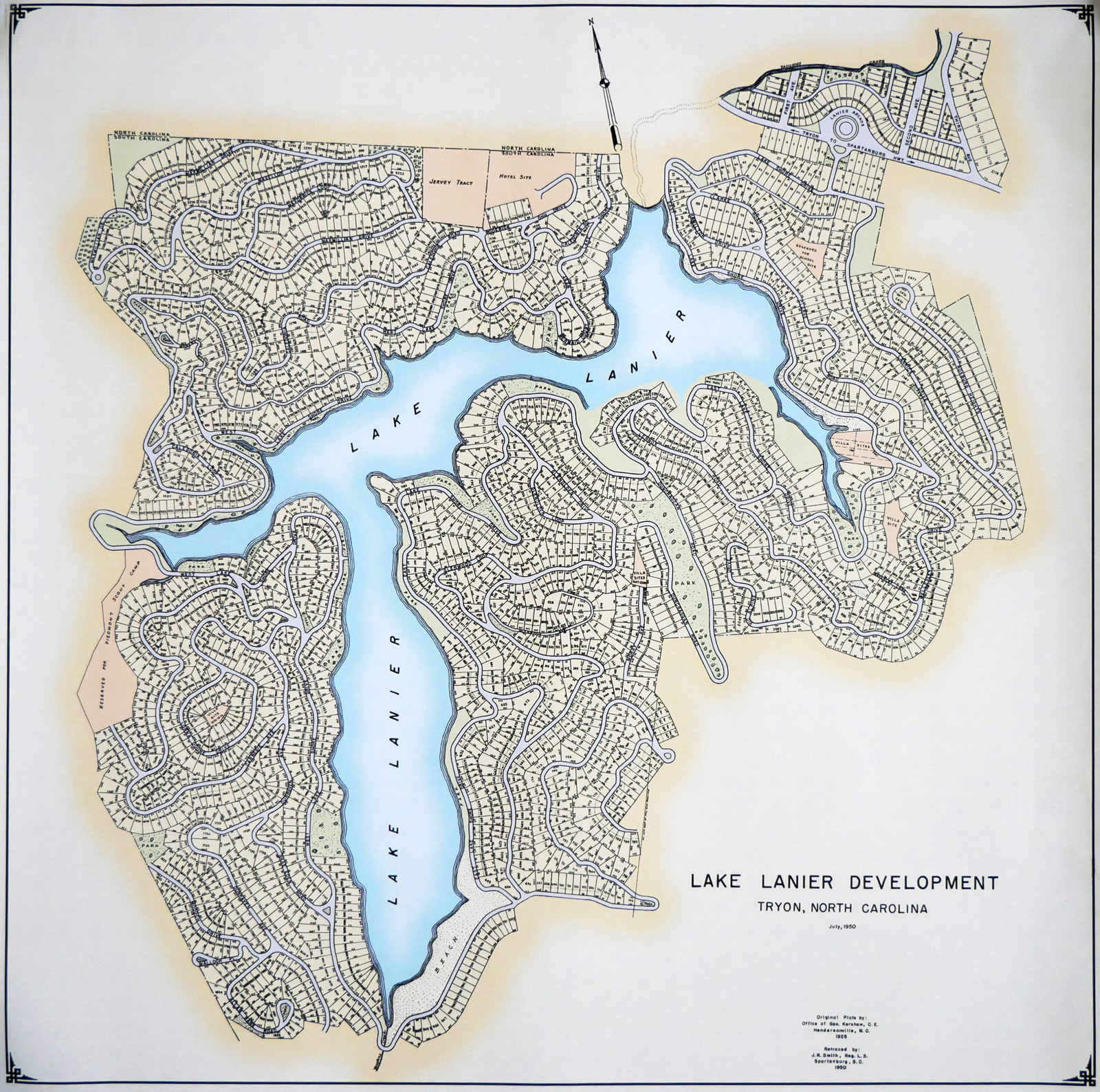
George Kershaw (1878 – 1950), civil engineer, early in his career worked on land development projects in Uruapan, Mexico where he met and married his wife Leonor, daughter of Mexican entrepreneurs who developed textile and coffee enterprises in mountainous Michoacan state. Their four bilingual children attended Hendersonville schools. George retired from US Army Corps of Engineers in West Virginia. Kershaw’s 1925 plat includes site reserved for a school, a big beach, several small waterfront parks and larger ridge-top public park accessed from Duncraggan Road.
courtesy Frances Hyder Parker, Kershaw plat retraced 1950 by J.R. Smith, colorized
This project was first in the region to be motivated by “quality of life” and grounded in Design. Unlike other lake projects of the area, its purposes weren’t flood control or water storage for residential or commercial supply. Tryon already enjoyed adequate municipal water sources from mountain streams, and little Vaughn Creek’s watershed didn’t flood. Nor did it offer industry opportunity for power. Dams at nearby artificial lakes Summit and Adger already existed to generate electricity for industry and communities. From the outset, Lanier’s water was intended to be managed for esthetic and recreational purposes, at constant year-round lake level.
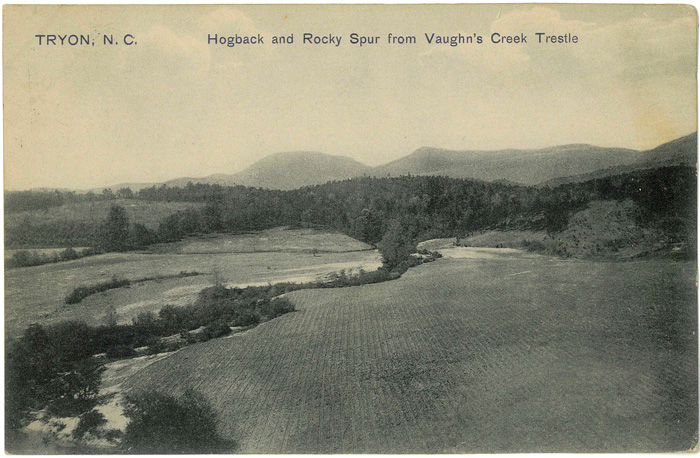
Circa 1920 postcard image depicts creek valley shortly before Lake Lanier development. Hogback Mountain and Rocky Spur, in South Carolina, are west-southwest of Southern Railway’s high trestle in North Carolina.
Capable community leaders, including medical and educational people, joined with the board of trade to fund Tryon Development Company. Its goals weren’t fundamentally profit-driven and its economics weren’t underpinned by bank loans. Subscribers to the project were, in fact, publicly spirited individuals whose objectives weren’t dividends. There weren’t government grants nor subsidies. Town of Tryon got legal title to the lakebed and the dam itself, to manage in trust for the community’s welfare. This was, and remains, an unusual arrangement since those property assets aren’t even in the same state.
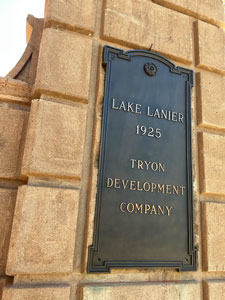
Tryon Development Company’s entry portals still flank the Highway 176 entrance on the North Carolina side. The hotel’s site straddled the state line on a hill above the dam, just inside South Carolina.
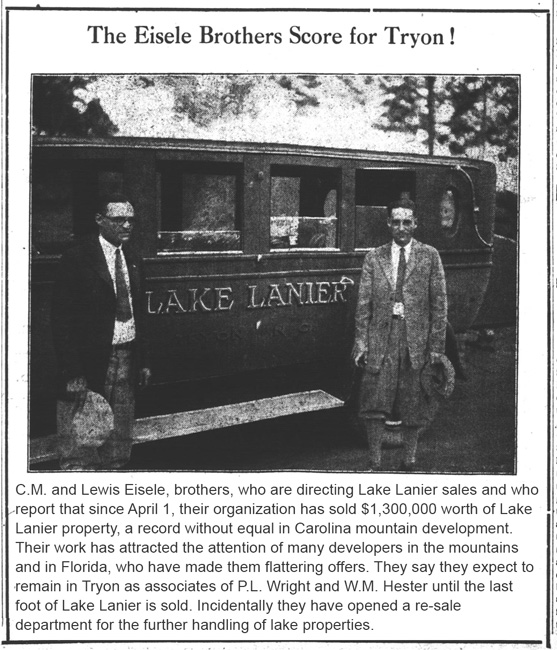
Polk County News feature with photograph of tour bus for sales prospects. Eisele brothers sold lots for well more than a million dollars at Lake Lanier during the Roaring Twenties.
Broader community consensus supported Tryon Development Co. for commerce reasons not formally articulated or quantified. The new paved highway from the state line to the existing town center was obviously Tryon’s logical corridor for commercial growth. Private investors would develop land along the highway from the Lake Lanier entrance, oriented toward thousands of people with their first automobiles heading to the North Carolina mountains. The project itself wasn’t zoned, but nobody expected retail businesses to spring up on the lake’s shores. Along the narrow entrance road near the dam, which is just over the state line in South Carolina, a low-key venture for a restaurant and simple inn came about. Lake Lanier Tea House was designed by Tryon’s cosmopolitan architect J. Foster Searles, constructed of logs in picturesque “Adirondacks” resort style.
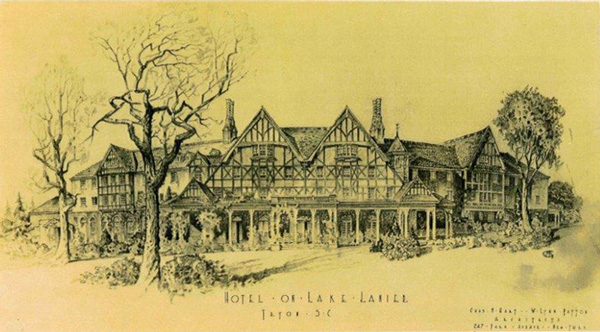
New York City architect firm created this sketch of Tudor-style luxury hotel with broad verandah to overlook the new lake. Civil engineer Anson A. Merrick vetted the building site, but financing was aborted in late 1926 when money dried up for speculative projects in Florida and the North Carolina mountains. A less-costly hotel opened spring 1927 at bigger Lake Lure in nearby Rutherford County.
In 1920 the railroad up from South Carolina was yet the way most travelers first viewed Tryon. Emerging from the deep Rock Cut at the state line, trains ascended to impressive Vaughn Creek trestle built in 1877. From left-side windows passengers saw the broad, undeveloped valley and forested mountains beyond, before their train slowed for the important stop at Tryon Depot. Soon new Lake Lanier named for Tryon’s poet became their view over the valley. Had the hotel been built it would have been their first glimpse of fashionable 20th century Tryon.
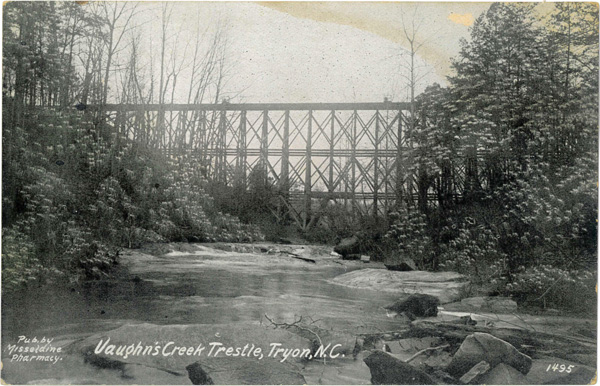
Before 1943 trains from South Carolina steamed into Tryon Depot over this long, impressive trestle.
It takes imagination now to appreciate the visual impact back then of Southern Railway’s long, high trestle that spanned the creek. In the 1940s it was filled in by banked earth around an enormous concrete culvert. Today highway travelers rarely are aware of the elevated railroad track behind prosaic 1960s Tryon Plaza shopping center with its barren parking lot. In the ‘50s the area’s first drive-in theatre was there. But before World War II any visitor to Lake Lanier witnessed the big trestle looming large above the land, affirming Tryon indeed was a mountain place.
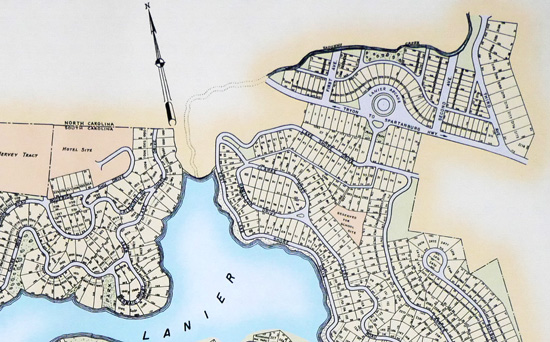
Kershaw’s 1925 plat for Lake Lanier development shows lots platted for a pretty crescent of shops, Lanier Arcade, on trestle-side of the newly-paved highway, and behind the shops a little parkette beside quiet Vaughn Creek.
The original short dam over Vaughn Creek had no roadway over it. Soon after its construction the concrete dam collapsed. Quickly the development company found a new engineer. The new dam has survived a century. A narrow road supported by a nearby bridge enables cars to circumnavigate the lake, nearly five miles of shoreline mostly lined with small cottages. Few of the numerous platted lots not by shoreline were ever built upon; the Depression that hit in 1929 essentially stopped all new construction. Nor do the planned neighborhood streets exist on surrounding hills, with minor exceptions. What was visioned as a major suburbia remains forested. The historic Tea House is renovated as a private residence. There’s no public access and the lake has a distinctively private atmosphere.
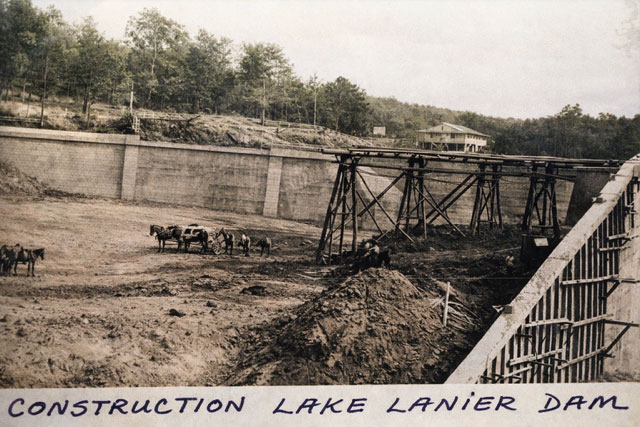
Equines and drag-pans were how you accomplished major grading in the 1920s. A failure of Lake Lanier dam could have threatened integrity of the vital rail trestle and the highway. Tryon Development Company’s dam wasn’t earth-filled, it was built of concrete with reinforcing bar. Despite such precautions the concrete gravity-arch St Francis Dam, built the same time near Los Angeles, famously collapsed in 1928 killing 431 people in the subsequent flood. Defective soil foundation was determined to be its major fault.
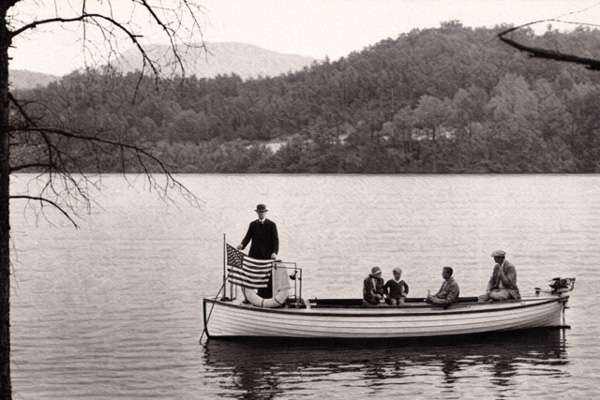
Wood boat with early outboard motor cruises new Lake Lanier for publicity photo in 1926. Similar to Tryon’s nearby Gillette Woods development, most home sites offered mature woodland, not clear-cut forests abandoned after timber harvesting.
Shortly before Tryon Development Co. built Lake Lanier, the Boy Scouts were deeded property that became lake-front. For many decades the scout camp brought summer visitors from near and far. Old postcards celebrate the camp, its canoes and other non-powered rowboats. Planners in the Twenties didn’t design Lake Lanier for big powered boats. The lake is intimate; in years past residents could take small boats to dock by the old Tea House which was a pleasant social center. Many people fondly recall its nice meals, outside on its flagstone terrace as well as inside the “Adirondack lodge” served elegantly by professional white-jacketed Black waiters. Preceding annual Block House Steeplechase, a black-tie Calcutta Dinner was held there sponsored by Tryon Riding & Hunt Club. Typically dogwoods were in full bloom, then, and lush rhododendrons too.
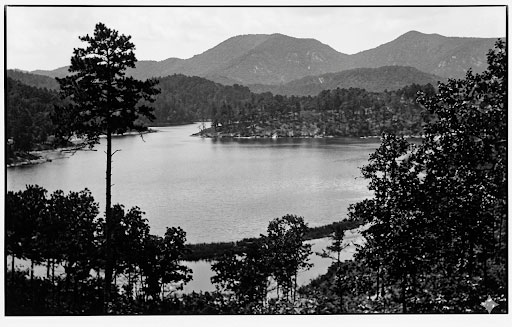
After the new lake was filled behind the dam Polk County News published a view of the scene. A digitized halftone image that survives is rough, so a
Tryon native has deployed Artificial Intelligence software to make it pretty.
courtesy Jim Vining
Lake Lanier is a typical early 20th century example of planning. Commercial concerns recognized the power of positive esthetics, especially for platting roads and lots that take into account hilly topography. The professional discipline of Civic Planning, however, was in its infancy. Although in Britain there came about a professional society in 1914 for development planning and a university degree program in 1909, these had yet to influence development in the United States. American civil engineers and landscape architects looked back to Frederick Law Olmsted’s designs for inspiration, but he died in 1903 soon after completing his Biltmore Estate project during the 1890s. Tryon Development Company’s plan didn’t have integrated analysis of requirements for sewers, run-off wastewater control, roadway standards and maintenance, electric power distribution, fire protection and emergency access, nor modeling for traffic flows and automobile parking. Thus little build-out actually took place, for practical reasons. Similar problems to implement the Gillette Woods plat nearby were resolved, over time, by the political reality Town of Tryon could annex that development inside North Carolina, and levy taxes to pay for costs never planned or budgeted by its original developers.
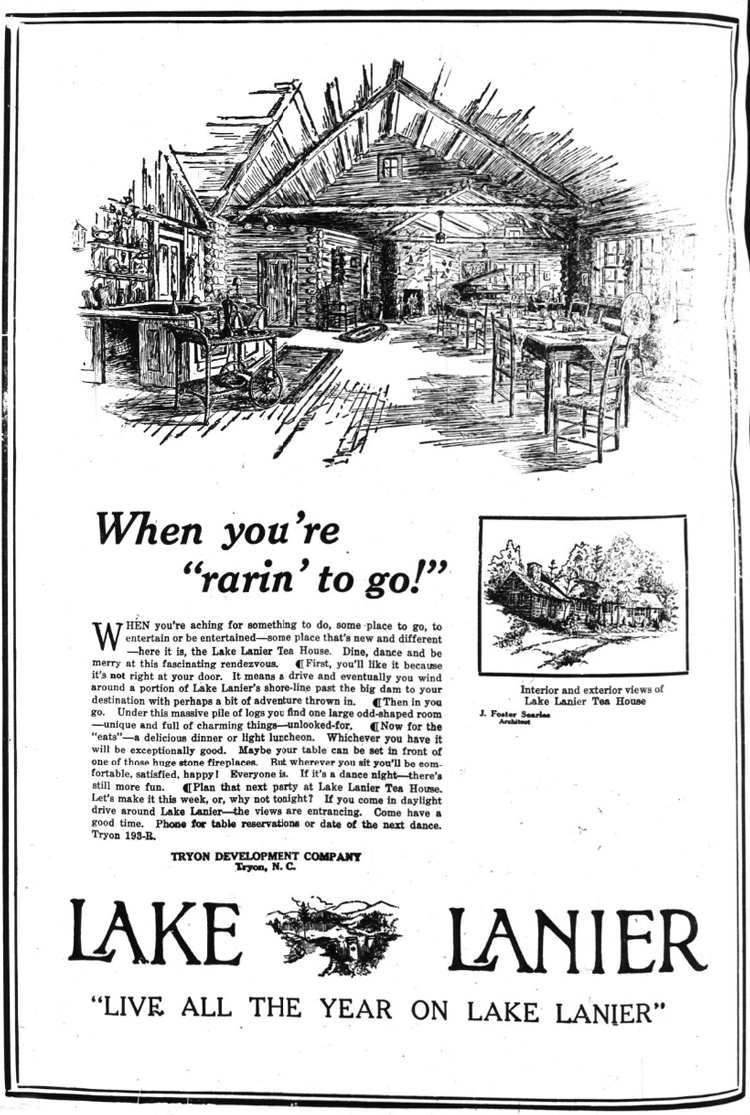
Tryon architect J. Foster Searles sketched picturesque Tea House and its rustic angled great room with log walls and two cheery fireplaces. A convivial little bar suggests alcohol-free socializing during Prohibition. There’s a grand piano and a wood floor perfect for dances. Tables and chairs for dining are simple “mountain style.”
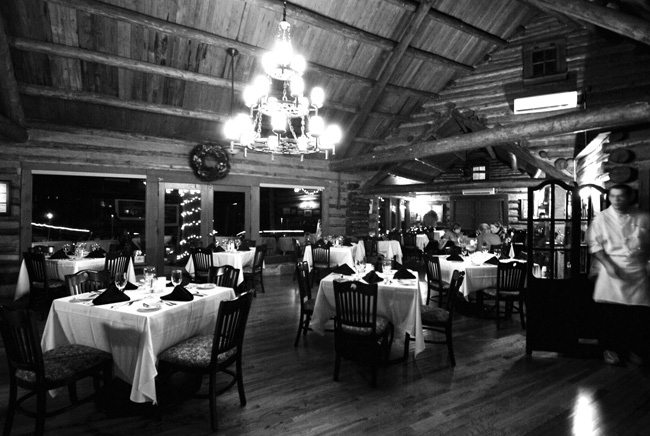
During the 1930s Tryon’s Rotary Club and Kiwanis Club met weekly for convivial meetings at the Tea House. Theo Kerhulas, Greek restaurateur, in the 1940s offered summer memberships for swimming on its the little waterfront beach. Transient guests could rent rooms into the 1950s. Interior of the great room is from 2009.
courtesy Elaine Pearsons, photographer
