Ligon Flynn: Modernist Architect
2009 images of Serendipity by Carolyn Ashburn, Saluda NC
2009 images of Moore House by Christopher Talbot, London UK

Entrance facade hugs the ridge. Kitchen windows form a corner at an obtuse angle.
Ligon B. Flynn was still an architecture student at North Carolina State University when he designed “Serendipity” as his parents’ residence in 1952. His father Broadus was Tryon postmaster. His mother was interested in design and loved construction projects. They had purchased the ridge called Country Club Heights, looking north over the golf course, and laid it out as several lots with good views. This home was the first built there. By this time Ligon had already designed two Tryon houses, and he was enamored of the oeuvre of Frank Lloyd Wright who in 1950 visited Raleigh to speak to a huge and admiring audience.

Following Wright’s philosophy, the young architect integrated the structure carefully with the sloping topography. On the entrance side the house is ground-hugging, rising from one-story multilateral hipped pavilions toward the massive central chimney. To the rear, the fall-away lot reveals a two-story house with a glassed façade for the great central room, which also has clerestory fenestration. This dramatic six-sided, sunken room was designed to seem “half outdoors” enveloped in glass, and “half indoors” with steps flanking a Wrightian open fireplace. Elsewhere, Serendipity’s windows are continuous ribbons under broad eaves, in the Wright style. Walls throughout the house take obtuse angles; there are no rectangular rooms.

Flynn was in State’s first class at new School of Design under faculty assembled by dean Henry Kamphoefner, a brilliant group that included Buckminster Fuller, George Matsumoto, and abstract painter Duncan Stuart. There he was involved in creating the Atrium Mural, a plaster relief masterpiece designed by Manuel Blomberg; Ligon skipped so many classes to work on it that his degree was delayed many months. He went on professionally to become the fourth architect ever awarded the $10,000 Kamphoefner Prize honoring designers demonstrating sustained commitment to the Modern Movement, and later served on the committee that selected many winners.
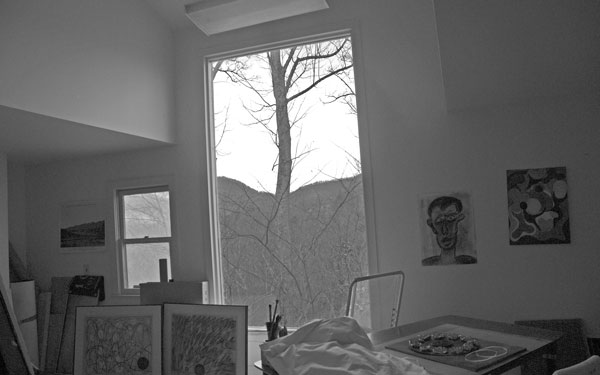
Studio with north light and expansive view toward Howard Gap.


Ligon Flynn used a folded napkin to work out his design for inverted trusses to support the living room roof. Truss structure, a regular hexagon, is covered with lapped Western redwood. Recessed lights, an early application of fluorescent tubes for a residence, were designed by Holland Brady.
Another Ligon Flynn architectual marvel was designed for Mary Flynn and Tom Moore, who both grew up in Tryon, a young couple typical of the 1950s. Fond of entertaining, broadminded and intrigued by Modernism, they decided to build a new house.

Mary’s brother, Ligon, and their brother-in-law Holland Brady were young architects early in their careers. They collaborated in this design, with Ligon working out of his Raleigh office and Holland moonlighting while still employed by Tryon architect Shannon Meriwether. Both Flynn and Brady earlier had designed houses while under the spell of Frank Lloyd Wright; in this commission they emerge out of Wright’s influence toward a new direction. It is a tour-de-force of complex curves and angles, constructed without many of the tools contractors use today.

Example of some of the complex exterior window angling.
The building is on a slope falling away from street level. Because the best view is in a particular direction, the plan concentrates attention toward a narrow concave rear façade, completely glassed, convex inside to a tall living room a full floor level below the street. This dramatic space splays to a dominant concave interior stone wall, with three steps descending midway through the room toward an off-center sunken alcove tucked beneath the balcony dining area. Side walls continue the same stone of the interior through to the exterior, where these walls terminate raggedly, like a rough bastion or buttress.
This house has been enlarged and altered, over a period of some fifty years, by both the original designers. After the Moores had children, Flynn designed a complementary addition all of wood, in the style called “contemporary” in the 1960s. This space has been remodeled in recent years by Brady’s firm for the present owners, who revel in unusual houses.

Unsupported stair treads of Southern pine are embedded one foot inside the concave stone wall. Women in high heels carrying cocktail glasses in the 1950s were expected to descend these steps gracefully, without the handrail added later.

Panels of dining balcony and ceilings are birch veneer, accented with redwood.

Curved walls of cypress with recessed redwood battens. The floor plan has no definite room boundaries. Beyond this study area is glimpsed the intimate sunken alcove of the living room, with its fireplace and built-in couch concealing a heating duct.
After 2009 both private homes were acquired by later owners.