
Thousand Pines
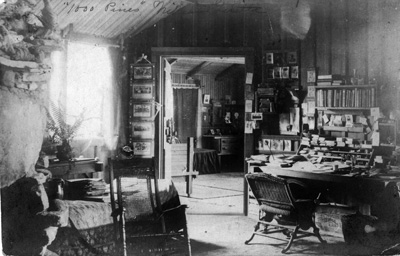
vintage postcard
courtesy Linda Merrick Frieze
In the late 19th century when much of Western North Carolina’s virgin woods were clear-cut, a few landowners such as G.W. Vanderbilt at Asheville and J.A. Estabrooks at Tryon introduced scientific silviculture to restore the forest. Other prominent people purchased tracts of valuable old-growth timber to preserve them. William Gillette, Hartford-born playwright and famous Broadway actor, in the 1890s began acquiring wooded tracts between Tryon village and the South Carolina line for a winter retreat he named Thousand Pines. His 700-acre preserve became nationally known and attracted many influential visitors.
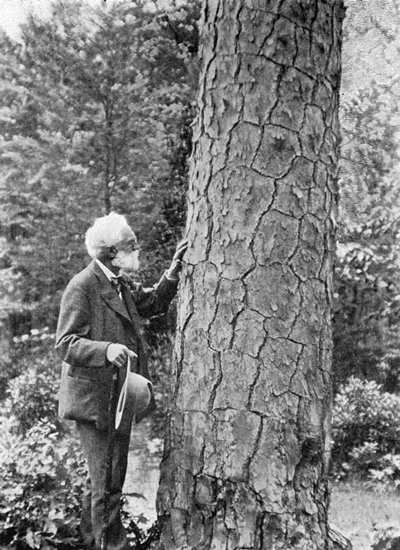
Morley depicted George Warner admiring a huge old-growth trunk at Thousand Pines, in her 1913 book The Carolina Mountains.
Gillette’s sister and her husband George H. Warner, brother of influential journalist Charles Dudley Warner, retired there in the early 1900s, contributing to Tryon’s flourishing as the Southern counterpart to the famous Nook Farm circle of Hartford artists, writers and intellectuals. Another of that Hartford group, energetic author Margaret Warner Morley, settled permanently and was the most important early female photographer documenting North Carolina’s mountain landscape and “mountaineers”.
On a knoll with a 360-degree view, in 1892 Gillette constructed his cabin. It was simple frame preceding the later fashion for round logs in the Adirondack style with brown stained board-and-batten walls, ceilings, and exposed rafters. There was no plaster. Windows were stock four-panes. On the downhill side an expansive wooden deck built atop rot-resistant locust posts, unusual
for that era, presaged this feature now so popular it's virtually de rigueur for residential design in the region. The Warners enlarged the cabin in compatible style. It was further enlarged and altered in the 1920s when made into an inn. In recent decades Thousand Pines is again a single-family residence. All the owners have preserved to a remarkable degree its unpretentious, casual architectural features and furnishings.

Thousand Pines is in mountainous Gillette Woods, transformed from William Gillette’s rustic preserve during the 1920s into a prestigious residential neighborhood designed by Indianapolis landscape architect Lawrence V. Sheridan. Large irregular lots are along winding roads that follow the terrain. Sheridan’s scheme incorporated extensive bridle trails and preserved much of the old forest.

Enlarged several times, the original two-room cabin was connected by covered walkway to a separate kitchen cabin. The dwelling had no electricity or interior plumbing. The unusual screen Gillette designed incorporating rattan material, seen at left, survives from his time.

Gillette had his bed by this fireplace in cold weather.
The fieldstones of this picturesque fireplace are stacked far more rustically than the rudest early Carolina mountaineer's cabin. It is unchanged from an 1892 watercolor by Amelia Watson, his guest from Connecticut who later settled in Tryon, and period photographs documenting it in the Harriet Beecher Stowe archive, Hartford.

Designed and fabricated by William Gillette himself, this door is similar to the very unusual doors in Gillette’s Castle, his later and much grander Connecticut country retreat. There also can be seen his early Tryon-vicinity folk ceramics and his Tryon artist friend Lois Wilcox’s landscape painting depicting Thousand Pines.
Photographs by Elaine Pearsons
