
Villa Barbara

To some an Italian country villa in the Appalachians may seem odd, but the motif dates back to 1890 when influential architect Charles Adams Platt designed a villa in the mountains at Cornish, New Hampshire. After he published Italian Gardens in 1894 the style rapidly gained favor for country houses, from New England to lakes in Wisconsin. Architectural philosophers considered Italian villas especially appropriate for the South, where they were popular until Mussolini took over Italy in the 1920s. They are found as well in Biltmore Forest and elsewhere in North Carolina’s mountains.

Born in Wisconsin and educated at Williams College in the Berkshires, designer Ralph Child Erskine was well-acquainted with the style. He commenced Villa Barbara after his move to Tryon to live, near his mother at Lynncote, in 1910 with his young wife Barbara, a poet. It is well-suited for year-round residence. Large ribbon windows help warm the principal rooms in winter. The north loggia, with its pair of red Verona marble baroque columns, offers shade and breeze in summer. The west entrance, approached via a vine-shaded pergola on Corinthian capitals, originally was a recessed loggia with a sleeping porch above. Erskine’s older brother Harold, architecture graduate from Columbia, was studying in Paris at the Ecole des Beaux-Arts at the time; he may have assisted with the plans. Harold is known to have designed the 1908 Congregational church in Tryon in the Arts & Crafts idiom.
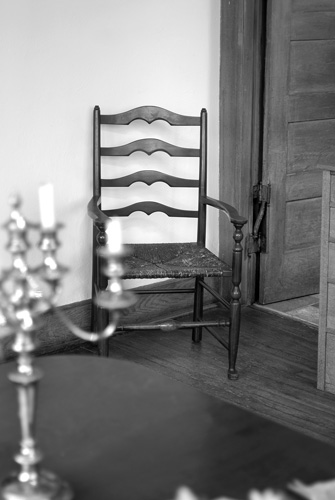
Chair designed by Ralph Erskine and made in his
Tryon factory around 1912, with original rush seat.
Erskine’s furniture operation integrated Arts &
Crafts principles of workmanship with America’s
emerging interest in its
colonial-era heritage.

Trophies of Henry Bartol’s 1930s Africa hunt, prior to his marriage to Margaret Carol Erskine, displayed at the stair landing. Newel posts in the house are pyramids topped by spheres, an allusion to the Renaissance.

Massive weight-bearing beams of solid timbers, informal stone fireplace, simple moldings.
The interior is elegantly simple. Ralph in 1907 authored, and illustrated with his own photographs taken in the Tryon vicinity, his seminal article “The Handicraftsmen of the Blue Ridge” for Gustav Stickley’s influential New York magazine The Craftsman.
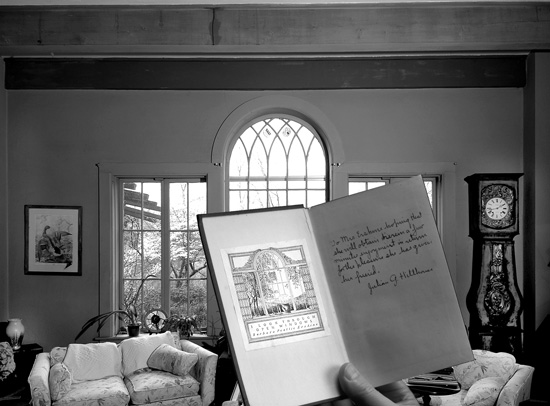
Bookplate of Barbara Peattie Erskine, depicting the identical Palladian windows at opposite
ends of the living room. Facing east and west, these windows offer maximum solar gain
during winter. In summer when trees leaf out, both may be opened for cross-ventilation.
Photographs by Chistopher Bartol
The Villa Barbara
What makes my villa dear to me?
Whisper of pines on a windy hill,
Splendor of sunset, golden and still,
Silver thrush from darkening wood,
Mountains wrapped in a misty hood,
Hearth alight with pungent pine —
Why love I most this home of mine?
Sound of laughter out on the lawn,
A child that wakes and sings in the dawn,
A baby who watches the windy sky,
And marvels at cloud-ships sailing by,
A hand that touches the 'cello strings,
A voice that lifts the heart when it sings,
Eyes that can charm, lips that can heal,
Hands that hold my whole life's weal —
What makes my villa dear to me?
Not wind or weather, but just these three.
Tryon, N.C., March, 1912

