
Louis Rowell
1870 - 1928

Carrying canvases to paint plein air
circa 1910
courtesy Rachel Jackson Bunte
Many people have visited Tryon and raved over its charming scenery, but Mr. Rowell has portrayed its full beauty with the brush and imprisoned it for future generations. It is the atmosphere that the artist has caught, the soft lights, the quiet charm, the inscrutable mystery of lights and shadows.”
Atlanta Journal
Deep in the heart of the mountains of Western North Carolina lives their most loving interpreter, Louis Rowell. . . For him they have donned their purple rain clouds, or put on their daintiest garments of mist, and repaying loyalty with loyalty, have even showed him how to paint the air which lies beyond them.”
Caroline Fuller, Boston author and critic
Unlike most other Tryon painters who arrived with sophisticated training and artistic maturity, Rowell (pronounced “Role”) came to Tryon as a young man, developed his skill while living there, and rarely left the North Carolina artists’ colony. For more than thirty years he lived in Tryon, painting landscape prolifically, and many of his works exist in local collections. He was virtually the only Tryon artist who actively marketed his work in Asheville during the period.

Rowell’s home & studio, Melrose Circle
circa 1912 as originally built before additions
courtesy Mary LeDuc Rowell Wissick
Rowell was born in Vineland, New Jersey. His father was an Oberlin College graduate, ardent musician, and Union veteran from Maine whose health was broken by military service during the Civil War. In his sixties Franklin Rowell and his wife, who had developed tuberculosis, came to North Carolina seeking to regain their health. Both died in Tryon. Louis, then in his twenties, stayed on and found the village atmosphere congenial among the kind people who had helped his parents during their last days. Special friends were the three LeDuc sisters whose brother had been a Union general and later served in the administration of President Hayes. Louis was an accomplished singer and pianist; he played impressive interpretations of Chopin. His talents were much in demand for Tryon’s frequent musical events, and he made a modest living by giving music lessons.

Sunrise on Lake Lanier, Tryon
oil on board 10 ¾ x 12 ¾ in.
courtesy Mr. & Mrs. Arie Ilton
Certainly Rowell had no meaningful art experience before coming to Tryon. His early watercolors are crude in technique. Yet he had an eye for color, a pleasing personality, and loved to practice painting. His eagerness motivated sympathetic artists to train him. As time went by and Tryon attracted greater numbers of experienced painters, Rowell benefited by observing their work and by their coaching — though he probably never paid for formal lessons. He would pay for meals and other things by bartering his pictures. He became successful enough that he was able to build his own little house and studio on Melrose Circle, next to artist Amelia Watson’s, and he rented space annually at the Lanier Club to show and sell his art.
He also exhibited in Asheville, at the swank Battery Park Hotel where visitors stayed from all over the nation. An Asheville newspaper records in 1908: “The watercolors which won the most favorable criticism were the autumn scenes. A characteristic of Mr. Rowell’s work is the subtlety of the painting of the mountains, which loom vaguely in the distance, veiled in blue. The effect of the sun on the far away mountains is remarkably well represented. Another distinctive feature of Mr. Rowell’s work is his special gift for painting water. . .Mr. Rowell has done some excellent work which has received flattering notice throughout the country from art critics of note.” His paintings of North Carolina were exhibited in Atlanta and Charleston as well.
In an interview with journalist Sylvester Edmonds, Rowell articulates his philosophy: “Technique is every artist’s individual way of getting his effects. It should stand for that and nothing more. As there are thousands of individualities, so there should be as many separate techniques; the object being to express the thought as simply as possible. Thus may be seen the futility of copying the method of the master. The spirit of art is unteachable. A true artist paints because he cannot help it. The most that tutoring can be expected to do is to develop what is within. In my opinion a painting has only two reasons for existing: it must either express a great thought or it must be a thing of beauty within itself.”

Melrose Mountain 1922
oil on board 20 x 16 in.
courtesy William Ryan & James Boyle
Like his artist friend Margaret Morley, who recorded the mountains photographically, Rowell enjoyed exploring the higher, wilder elevations in western North Carolina. It is known that he would stay at Balsam (southwest of Waynesville) and that he hiked with Warren Converse and Nelson Jackson in the Cashiers area. He would carry his artist’s materials along and work plein air. In Tryon, too, he was often seen outdoors, either with his lapboard or working on an easel. He was one of the most ubiquitous artists in the colony, in all seasons, and seldom left the state. Rowell patronized local distillers, who made quality beverages appreciated both by locals and by many worldly visitors to Tryon; these moonshiners’ trade especially flourished after North Carolina legislated Prohibition in 1909.
By the 1920s he had become a skilled painter in oils. In 1926 he had his first New York show, at Denks Galleries on 57th Street opposite Carnegie Hall. It was a critical and commercial success. This event took place during the period of national Prohibition — when the big city was a dangerous place for those who acquired hooch from strangers. Rowell returned from New York suddenly stricken ill, arriving back in Tryon physically and mentally devastated.
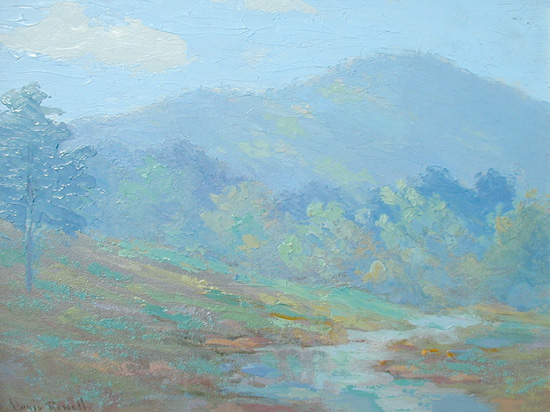
Vaughn’s Creek
oil on board 9 ¼ x 12 ¼ in.
courtesy William Ryan & James Boyle
For the last two years of his life Louis Rowell was a wretched figure. A kind and understanding young friend, Charles Mackay, the musician son of an Episcopalian minister, tried to help him in Asheville. Rowell was in and out of the psychiatric hospital, Appalachian Hall, which bankrupted him. He attempted to live and paint in a single room downtown in the Nat Green Building, adjacent to Mackay’s music studio, but accomplished little there. Rowell died in the Asheville sanitarium of “exhaustion from mania” August 1, 1928 and was buried furtively in Tryon Cemetery, the news not being made public until after he was laid to final rest. Probably no headstone ever was made for him, and his grave cannot be located. He had become estranged, around the time Prohibition was legislated, from his younger brother and his stepfather (Edward Payson Powell, clergyman and author of such books as The Country Home), who both lived in Florida.

The Green River Road
watercolor & pastel 11 ½ x 9 ¼ in.
collection of Michael McCue
A second, memorial exhibition was held at Denks Gallery later in 1928. Another posthumous show and sale of Rowell’s paintings was held at Sunnydale in Tryon.
Much of his art is extant, but no known public institution exhibits any Rowell works, except for one small oil at Tryon’s Lanier Library. The Kerhulas family, who formerly owned Sunnydale, now display a Rowell at Lake Lanier Tea House. Arie and Ann Ilton, then living in Florida, purchased a Rowell at auction some years ago. They were so inspired by the painting that they decided to seek out the locale the artist had depicted. When they found the place, they became so captivated that they soon made a mountaintop near Tryon their new home.
