
Grace Clemons: Music in Early Tryon
From its earliest days the Tryon colony attracted musicians, among them pianists Hilda von Siller from Milwaukee and Louis Rowell from New Jersey. Mrs. Dowe from Connecticut built her private Opera House on Melrose Avenue in the 1890s, venue for many musical evenings with the little Tryon Orchestra which included Sidney Lanier junior, son of the poet. Madame Talma, opera singer in New York, was daughter of Dr. Garrigues the famed obstetrician. From Europe came Alexandra Human Blum, born in Saint Petersburg, opera star in Budapest and Vienna during the late 19th century.
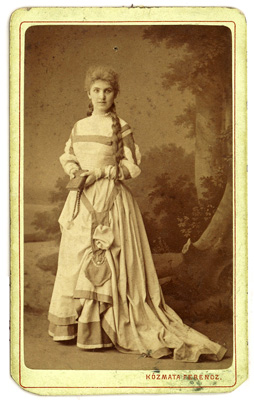
Alexandra Human in stage costume at Budapest
courtesy Keith Bollman
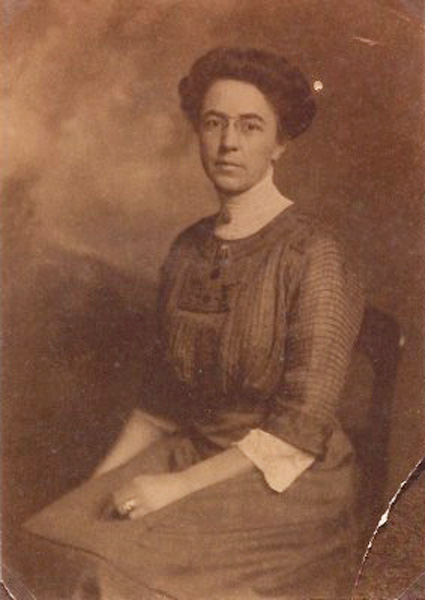
In 1910 Grace Downs Clemons (1871 – 1957) arrived with a coterie of Chicago people for a sojourn at Log Cabin Inn on White Oak Mountain. An accomplished pianist and singer, she was recently divorced from her husband, proprietor of Clemons & Crane – one of the many firms active in Chicago, then America’s highest-volume center for the manufacture and marketing of pianos. He had designed for Grace a special piano in a case of rich black walnut. Though she left her husband, she kept his grand piano. It remained in Grace’s home in Tryon for decades, in the room designed for it in scenic Gillette Woods.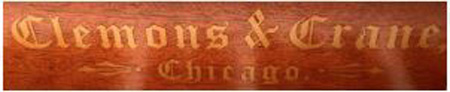
fallboard decal on vintage Clemons & Crane piano
Like many women with cosmopolitan backgrounds, Mrs Clemons joined the Lanier Club. Its building constructed in 1905 was, then, a library secondly and a clubhouse primarily. Central space with a fireplace, surmounted by a big niche for the bust of Lanier, poet and flautist for Baltimore’s Peabody Orchestra, professor at Johns Hopkins and theoretician on the nature of sound. This assembly room served the Tryon public for lectures, art shows, and music events. Even teas and private evening parties, smoking permitted. Two or three afternoons per month, members and their guests gathered for club programs. During 1910 the programs included a talk “Musical Conditions of Shakespeare’s Time” with interpretations of songs from the Bard’s plays, another a concert of songs by a children’s chorus and a harp solo, another a lecture “Scotch Poetry and Music” followed by Bertha Payne Newell singing Scots airs with piano accompaniment.
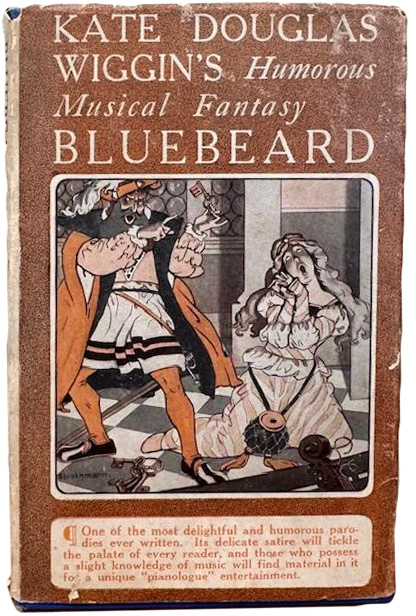
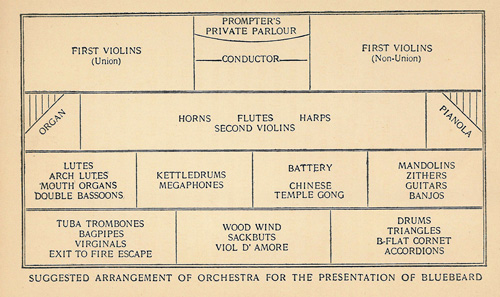
Much of Lois Wilcox’s 1914 spoof is difficult to appreciate without deep knowledge of Wagner and the era’s music conventions.
Bluebeard’s orchestra arrangement offers a glimpse, however, of the humor of
Wiggins’ satire.
In years following music at Lanier Club figured prominently. A program about poets Browning was interspersed with piano selections composed by Chopin, Liszt and W.C.E. Seeboeck (Vienna-born student of Brahms who in 1880 immigrated to Chicago, wrote the opera The Missing Link and some 200 other works, and died there in 1907). Their innovative education program about bird species included bird songs by the singing class of professional artist Lois Wilcox and bird music on piano played by Isabel Missildine; she led Tryon’s Ladies Glee Club and they sang for other programs. In 1914 Wilcox presented a hilarious lecture-recital Bluebeard: A Musical Fantasy, parody published that year in New York. (Its author Kate Douglas Wiggins explains “herein lies the story of the miraculous discovery in a hat box of an unpublished opera by Richard Wagner dealing in most unique and climacteric manner with feminism, trial, marriage, bigamy and polygamy; its libretto and leit-motive now revealed with religious zeal.” Her dedication was “to my friend Walter Damrosch,” famous champion of new American music.)
Not all performers at Lanier Club events were women. Flute duets were played by brothers Harold and Lawrence Doubleday. Negro spirituals were sung by Arthur Alden Carver, recently returned from New York where he went for advanced voice training and to sing with professional choirs in Manhattan. Dwight Smith, actor recently retired from Broadway, would appear for dramatic readings. Conversely, women members would, not uncommonly, present on serious and even alarming topics.
Grace Clemons’ debut at Lanier was during a program of piano compositions in 1922, at which she performed solo. The club’s instrument was a grand, not an upright. At the time she was managing Ye Basket Tea Shop at Mountain Industries, a non-profit organization to benefit “mountain people” and less-fortunate residents in the area. In ’23 she accompanied a Thanksgiving vocal recital, and served the tea at Lanier Club.
In spring 1924 at another all-music program Clemons was accompanist for a violin duet performed by Anne Nash, raised in England, and precocious Tryon School seventh-grader David Strong. Although they concluded that event – presumably the “star position” for that program – no doubt its crescendo was in the middle, when Lawrence Mazzanovich sang accompanied by Caroline Beeson Fry. Mrs. Fry was wealthy and well-connected, a prominent New York vocal instructor sojourning in Tryon to mastermind the ambitious initial program of the new Tryon Choral Society. Mr. Mazzanovich, successful Impressionist painter and member of New York’s prestigious Salmagundi Club for artists, came from a musical family. Lawrence’s vivid personality and powerful bass-baritone voice (his mother was Italian, so it might be said his was a so-called Verdi baritone) charmed the ladies. He deserted his son and his wife, who refused to grant him divorce, to settle in Tryon. He’d begun his meteoric rise in fine art in Chicago, where one of his finest big Tonalist paintings was honored with the Purchase Prize of 1913 at the Art Institute.
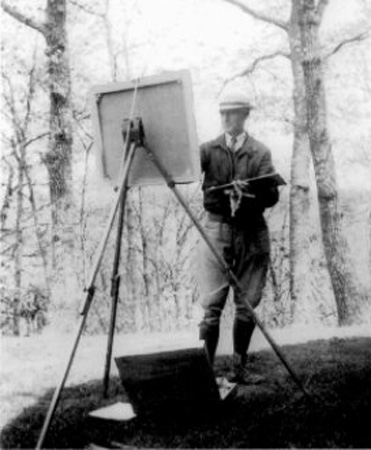
Mazzanovich painting plein-air.
A Russian song by Koenemann he soloed in 1924 for Tryon Choral Society describes a king’s pomp riding into battle, in contrast to a poor serf’s fate who goes to fight for him.
His Tchaikovsky number expresses desire to become one with nature.
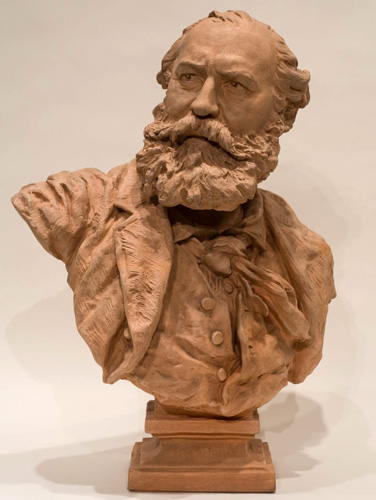
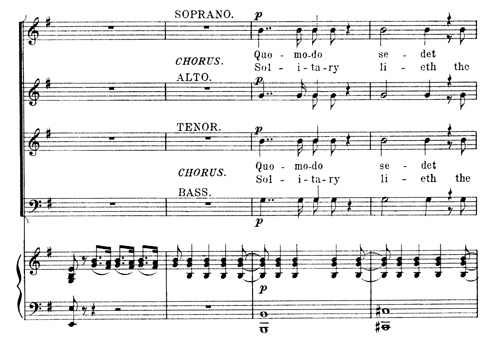
Charles Gounod's Gallia
Schirmer's 1900 score for chorus and piano
courtesy University of Rochester
Whether Grace and her husband had known Mazzanovich in the late 1890s in Chicago we don’t know. Grace and Lawrence were identical in age. But we infer they got to know each other rather well as Tryon Choral Society conducted its innumerable rehearsals that spring, under the expert and painstaking direction of Mrs. Fry. Grace Clemons sang alto in the chorus. Lawrence sang bass. Some people had been skeptical of such an ambitious program, given the small size of the Tryon community, but its concert at the new Episcopal Parish House auditorium was a grand success. Mixed chorus sang Orpheus with His Lute by Edward German (its lyrics taken from Shakespeare’s Henry VIII), The Plume Grass by Russian composer Yuri Sakhnovsky, The Brook by Arkangelsky, Heav’n by Burleigh (a Black spiritual first published in 1921). Women’s chorus sang Odel mio amato ben by Donaudy and Page’s Song by Harold Osborne Smith. Among the solo numbers, Mazzanovich sang Tchaikovsky’s The Pilgrim and Koenemann’s When the King Went Forth to War. The long program concluded with Gounod’s 1871 motet Gallia.
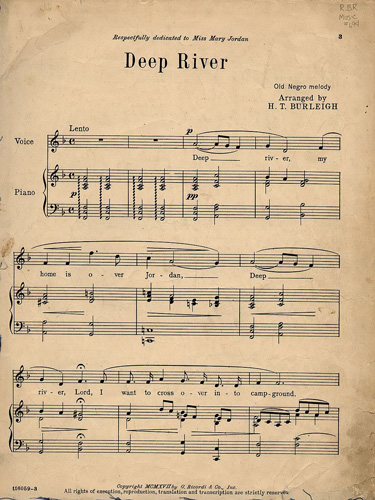
Burleigh's score as performed by Tryon Choral Society at their spring 1925 concert, Episcopal Parish House.
Tryon Choral Society met Monday nights for practice, and for spring 1925 presented another public concert. Mrs. Fry was occupied creating an even grander program (which deployed 2000 voices) that year in Westchester county, New York, so Mazzanovich was named music director. Grace Clemons was a piano accompanist this time, along with Isabel Missildine. A capacity audience filled Parish House on Monday evening, March 23. Clemons sang soprano. Women’s chorus performed several numbers, perhaps their most surprising (at least for the South) a Czech folk song Wake Thee Now Dearest. Audience responded so enthusiastically the women repeated that number. Mixed chorus sang such variety as Elgar, a Russian folk song, and another Black spiritual – Deep River as popularized by H.T. Burleigh in 1916.
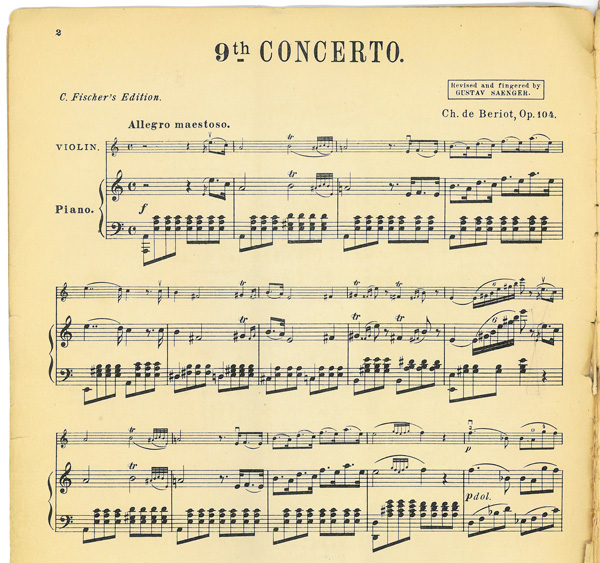
score fragment introducing
Charles de Beriot Opus 104
Concerto No. 9 for Violin and Piano
Carl Fischer's Music Library
Published by Carl Fischer, 1898
McCue collection
The 1925 concert is memorable especially for a violin solo by “mountain fiddler” Fannie Lindsey. She was 18, able to read and write, though married to an illiterate man who lived by Glassy Mountain. It’s not likely Fannie could read a musical score by Belgian composer Charles de Beriot, his three-movement Ninth concerto of 1858. It’s thought – though not documented – that Grace Clemons made Lindsey’s performance possible by coaching her in technique of classical repertoire. Clemons’ work with Mountain Industries inspired her interest in broadening cultural opportunities for Appalachia’s people; Fannie made her Tryon public debut that February playing violin at Lanier Club. (The club, a year prior, hosted a mountain songs program sung by girls from Saluda, masterminded by Miss Sarah Padgett working as Polk County demonstration agent.) Ear-splitting applause followed Fannie Lindsey’s 15-minute performance of the famous De Beriot. Polk County News reviewer gushed “Music is expression of thought in sound of another kind. Like an actor with a new role, Mrs Lindsey strained every nerve to make interpretations as impressive and attractive as possible taking advantage of contrast, climax, emphasis etc. in order to play upon emotions of audience. Her capacity for feeling, imagination and analysis, her sincerity in rendering with every movement, together with excellent phrasing and ability to modulate her instrument made us feel presence of beauty, the advent of new creation, the irresistible appeal to highest instincts of the soul . . .”
Arthur Carver’s professional career was coming along moderately well. Tryon Chorus planned and meticulously rehearsed several popular pieces of that era for the baritone as their featured soloist. Shortly before the concert Carver was stricken by one of his epileptic seizures, which brought about his death at 41 just six years later. Mazzanovich stepped in to perform other songs he knew well. The 1925 concert was another success, contributing to Tryon’s reputation for musical excellence.
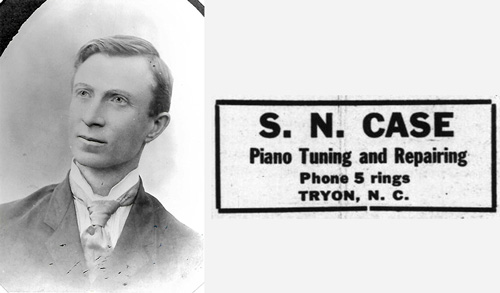
Stephen Nathan Case (1868 – 1961) and his advertisement in Polk County News
Tryon’s amenities for serious musicians included services of piano expert S.N. Case. Born in very-musical Iowa, his career in music took him to several cities in the Midwest and the Southeast, including Chicago the nation’s biggest piano manufacturing center at that time.
By his first wife from Sweden he had six children, by his second from Nebraska he had ten, including daughters Myrtle and Mary Elda born in Tryon. Sons, brothers and nephews were swept into Stephen Case’s enthusiasm for pianos, establishing retail enterprises and maintaining fine instruments. (Case Brothers Pianos yet exists in Spartanburg S.C. in fifth generation of ownership, with its fine private collection of unusual pianos going back to the 19th century.)
In 1925 Grace Clemons purchased a spacious lot in Gillette Woods, a new high-quality development on hilly land assembled by Connecticut playwright William Gillette. It was intended each home would be unique and architect-designed with landscapes to preserve the bosky character, especially mature trees and native shrubs. Her friend from Lanier club was married to imaginative architect John Foster Searles. He was well-off and took on clients only if the project interested him. Grace’s goals were unusual. The picturesque home Searles designed for her is one-of-a-kind, the only historic residence in Polk County before World War II created for the specific desires of a musician.
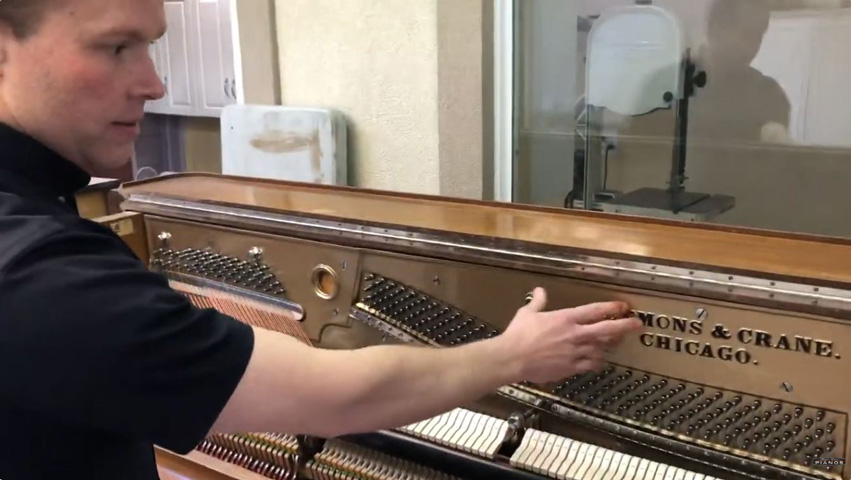
A vintage Clemons & Crane upright expertly restored in 2020 by Brigham Larson Pianos in Orem, Utah.
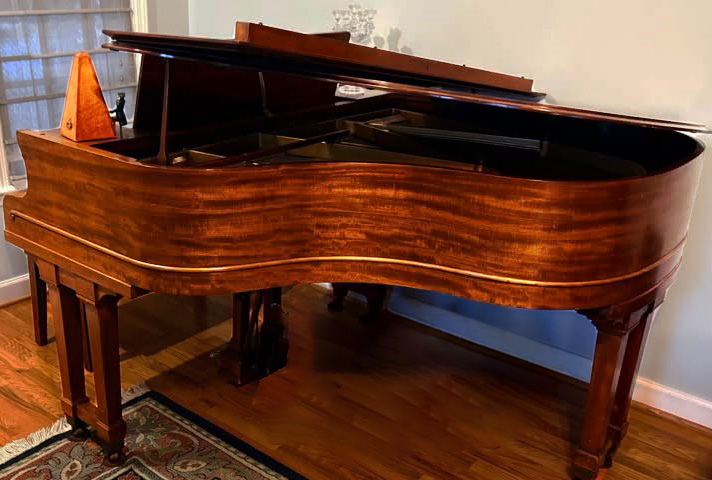
An elegant vintage Clemons & Crane grand has double legs supporting the keyboard ends. To move Grace’s prized instrument safely, such double legs were removed and re-installed.
Most important, of course, was her custom Clemons & Crane piano. Unlike most houses where locating the instrument was secondary, where it would go was paramount. From the front entrance (back then in Tryon visitors would often just let themselves in) one would see Grace’s face across her black walnut piano, and she’d greet them without moving her hands from the keyboard. If a fire were burning in the rustic fireplace, Grace could observe it from her playing position. There, cozy seating was arranged for visitors. To her right a pretty staircase with a landing led upstairs. Behind her piano bench came sunshine through the sunroom, while a long wall to her left (the long side of the grand piano) was pierced only by one small window, so as not to allow south-exposure sun to shine on her instrument at any time of any day. Solar gain on the long stucco-over-tile wall would help to warm the house on cold days, while a retractable awning over the adjacent terrace shielded the piano wall from heat on hot days. All such features, and many more for the Clemons house, obviously were thought through carefully, yet executed in a manner that seems perfectly natural and comfortable.
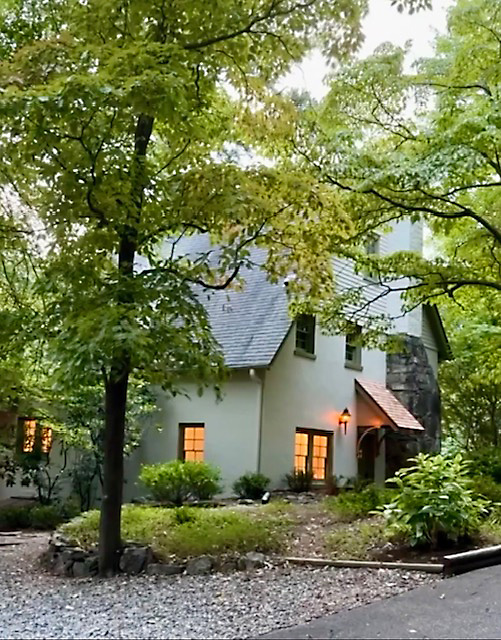
courtesy Donna Peay
Grace grew up in Wisconsin near Lake Geneva, where seasons can be extreme. Even in temperate Tryon air-conditioning in residences wasn’t known in 1926 when her Searles house was ready for occupancy. During summers then, fortunate Tryonites (who didn’t head elsewhere for the hot months) would care very much about ventilation and sleeping. Upstairs there are two spacious bedrooms, with direct access to a large exterior sleeping porch facing north. Views of woods and hills are beautiful up there, one or two adjacent structures may only be glimpsed even in winter, and these private quarters don’t face the quiet lane. A bedroom doorway conceals access to a full stairway to the extra-tall attic under a steeply-pitched roof; the space helps to temper the house in all seasons. There an architectural explorer discovers original knob-and-tube wiring, functioning as perfectly as when new. A counter-weight of heavy sash-weights dangles from an original cable over a pulley to the trapdoor over the stairs, also functioning as smoothly as the day it was installed a century ago.
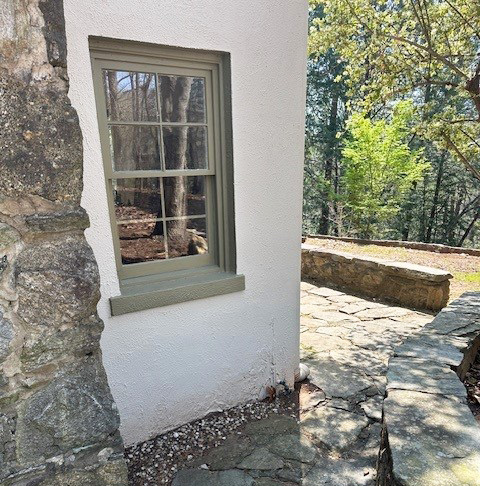
Outdoors, Grace’s landscape is as a 1926 newspaper describes. Extensive fieldstone masonry, matching the tall chimney’s walls, carries through the design concept of a quaint cottage set in an ancient forest. The site plan most likely was conceived by Lawrence Vinnedge Sheridan of Indianapolis, a 1917 graduate of Harvard’s School of Landscape Architecture who laid out the entire Gillette Woods project for Tryon investors. Sheridan’s designs for the hilly topography are so seemingly effortless as to appear never to have been planned at all.
Clemons’ broad flagstone terrace, with low fieldstone seating walls, is set upon a platform raised above a down-slope by a barely-detected retaining wall. Access from the house is via French doors from the sunroom, and by gently curving flagstone walks to the front entrance and to a private garden with a stone ring to encircle a sundial or a bird bath. To enhance the feeling of discreet privacy, entrance to her house from the narrow lane is down a quaint, short flight of stone stairs nestled into the ground. Around all of this is a combination of indigenous and cultivars, what remain of lush plants that must surely have been planned by Sheridan expertly.
Upon completion of her attractive new house, Clemons’ widowed mother resettled with her from Wisconsin, where Grace grew up near Lake Geneva. Susan Downs was a delightful old lady, a college graduate who loved the countryside, a fine companion. Her misfortune was to fall and break her hip. Complications ensued, and at age 91 she died of pneumonia. The body was shipped to Wisconsin for burial in February 1928.
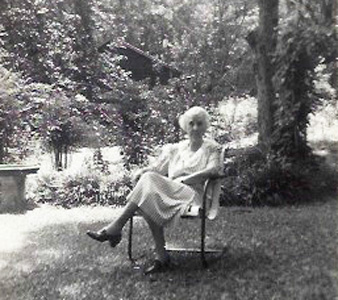
In spring 1928, alone again, Grace Clemons publicly exhibited her artistic photography. The medium was then becoming recognized as truly a meaningful visual art, but what her images were about we do not know. Most likely they were landscape. Late that year George Gershwin’s An American in Paris had its first performance at Carnegie Hall; a signal of shifting tastes it quickly became part of standard repertoire in Europe as well as the United States.
During this period many of Grace’s musical Tryon friends became enamored of horticulture, garden planning and forest conservation. Now that women could vote in elections they became, as the Twenties went on, ever more involved in social and political matters. Grace Clemons raised money for tuberculosis research. She was among donors to benefit Tryon Colored School; indeed one of her forebears had been a noted antebellum Abolitionist in New York state and actually had conducted a “station” on the Underground Railroad. Issues of racial justice were, even in the South, increasingly demanding more attention and more response – while Jazz and Black music generally were becoming more performed, more understood, more a mainstream trend in America’s musical life.
The next year the Great Depression hit America with full force. Tryon was fortunate, compared to many communities, but it was not spared. Soon the Lanier Club found itself weak financially. It pulled out of the national Federation of Women’s Clubs and took in male members for the first time. A sign of changing times was when Benno von Kahlden, long-time Tryon teacher and viticulturist, presented his “concert” for a Lanier program in 1930. It wasn’t live music, it was a session where he brought in his favorite music recordings and played them on a Victrola. We can only imagine Grace’s angst, as her ex-husband’s piano firm had gone bust, so now in Chicago he was selling music records for Victrola to make ends meet. That year Kay Swift became the first woman to score a hit musical for Broadway, Fine and Dandy.
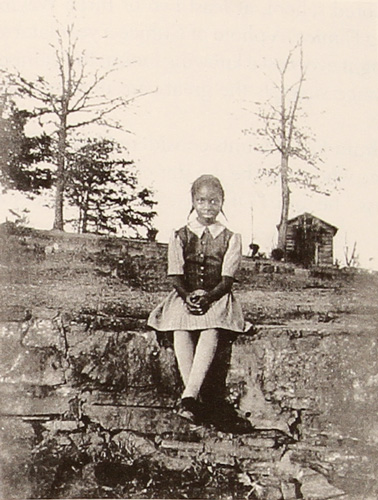
Nina Simone at 8 in Tryon N.C.
In 1933 Tryon’s most internationally famous musician was born, in a small house on the opposite side of Tryon from fashionable Gillette Woods. She was Eunice Waymon, daughter of the pastor at its CME church and a Black father who was a highly-competent independent entrepreneur. Very respectable people, their daughter was a musical prodigy who played piano publicly and confidently at a tender age. Soon her potential was so notable Miss Waymon was taking classical-music piano lessons in Gillette Woods with British-born Muriel Mazzanovich, the new wife of Lawrence the painter. She went on to attend a private Black high school in Asheville, then Juilliard. The goal of her white patrons was that Eunice Waymon eventually become the Marian Anderson of Black classical pianists. She had her own ideas, changed her name and eventually became Nina Simone, singer and composer who quite capably could accompany herself on the grand piano.
Other intriguing developments in Black American music occurred in Tryon while aging Grace Clemons was surviving the Thirties, besides the phenomena that many young white people were dancing to Jazz and buying saxophones. A young Charlestonian, DuBose Heyward, who’d once come up to Tryon to study art and later switched his creative field to writing, had published his hit novel Porgy that was made into a play. In 1934 he invited composer George Gershwin from New York to join him and his playwright wife, Dorothy, to spend the summer pleasantly at Folly Island near Charleston. Gershwin there decided to write the music for Porgy and Bess and went to work seriously on it.
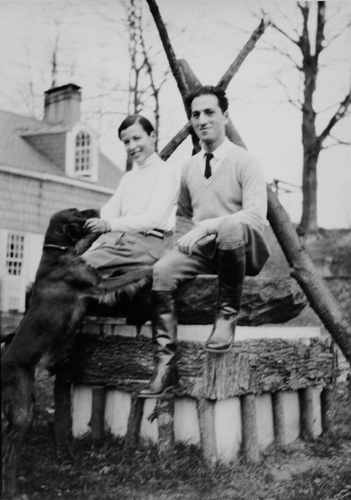
George Gershwin and Kay Swift
courtesy Katharine Weber and
the Kay Swift Memorial Trust
Joining them was composer Kay Swift, whose musical background was classical, her piano instructor well-regarded Norwegian composer Bertha Tapper. She had met Gershwin back in '25. The four of them made for a productive, remarkable team focused on creating a new kind of musical performance art. High-quality Black talents were hired. Plans were made to launch it for trial at Boston, then Porgy and Bess would go on to Broadway in New York.
Then as now, a road trip from the South Carolina coast to the Northeast could be a bore, so why not stop someplace nice? Heyward’s mother liked Tryon very much. She’d twice successfully produced ticketed programs about Gullah culture at its Episcopal Parish House. DuBose hadn’t been there for a while, but when he stayed in the North Carolina mountains his go-to physician was Dr. Jervey at Tryon who came from Charleston. Margaret Law, artistic wife of handsome young Tryon artist Homer Ellertson, had deep roots in Charleston and so her husband had painted and exhibited there. Homer had collaborated with an architect named Searles, to design Modernist wrought iron decorative elements for his unusual Tryon houses. The Ellertson home and studio El Taarn in Gillette Woods was really unique, jazzy it was said, and it had been featured in books and in a national design magazine. They had a standing invitation to stop by Tryon, for a visit to El Taarn.
So they did. The Ellertsons welcomed them warmly and the six enjoyed a languid luncheon on a beautiful Tryon day. The editor of the Tryon Daily Bulletin got wind of their get-together, but reported it next day as simply another social occasion when Tryonites were entertaining interesting out-of-town friends. From her house close by, Grace Clemons probably did not see nor hear anything. No doubt she was quietly gardening or playing something she liked on her piano.
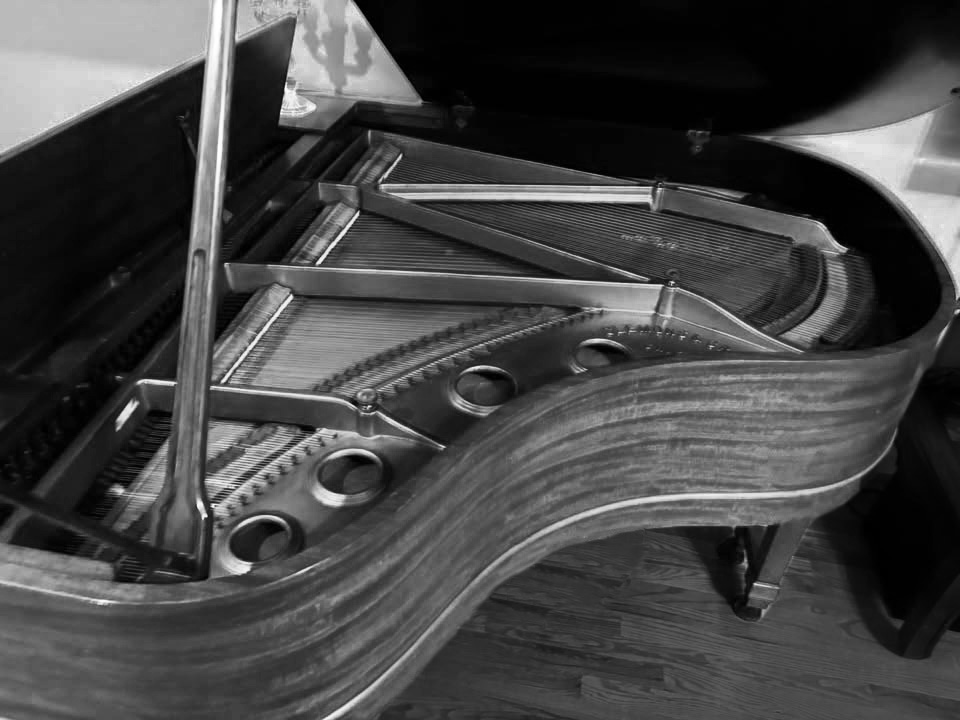
Lid of a vintage Clemons & Crane grand piano opens to reveal its “harp” or “frame plate” of heavy cast-iron (traditionally finished in elegant gold metallic) to keep more than 200 strings taut under extreme tension, a total stress force roughly equal to the weight of five elephants. Low-pitch bass notes deploy one string of steel wound with copper, upper base notes two, while each higher treble note has three thin steel strings activated by a piano key.

Questions or comments? Get in touch:
TryonHistory.org publishes original essays pertaining to Polk County, North Carolina before 1999. We’re not a history museum or archive, and we don’t conduct historical research for individuals or organizations.
-
111 Kangaroo Drive
Columbus, NC 28722
- (828) 436-2102
- info@tryonhistory.org
- © Condar Press. All rights reserved.