
How Tryon Came to Be

engraving showing the railroad, by Pennsylvania artist Frank H. Taylor for Health Resorts of the South (Boston, 1881)
Soon after the Civil War, Pittsburgh investors brought new people and fresh ideas to Polk County. Lemuel Wilcox (born 1815, Broadalbin NY – died 1889, Tryon City NC) was an entrepreneur and financier who made his Pittsburgh fortune in manufacturing and the oil industry. His sons, trained in civil engineering and business management, were well connected in the mountains of western Pennsylvania. Like many Northern investors, they perceived the western North Carolina mountains, lying some 400 miles south of Pittsburgh in the Appalachian chain, were ripe for development. Pennsylvania capital was already being deployed in West Virginia, southwestern Virginia, and east Tennessee.
Railroads were key to developing industry in the new territories and enhancing land values for timbering and agriculture. Before the war, Polk County plantation owner Dr. Columbus Mills (1808-1882), a prominent Democratic politician, had championed a railroad to connect South Carolina with the Tennessee River basin via Asheville. In 1864 Wilcox’s son, Lemuel North Wilcox (b. 1841, Pittsburgh – d. 1900, Tryon), married Anna C. McAboy (b.1842, Allegheny County PA – d. 1908, Polk County NC) in New York. This couple and her parents were the “Northern immigrants” who made Polk County their home in the late 1860s Reconstruction period, and would ultimately get credit for founding “Tryon City.”
“Were they ‘carpetbaggers’?” one asks. There were as yet no newspapers in little Polk County, but a June 29, 1869 article in the nearby Rutherford Vindicator describes local excitement over the arrival of Northern investors:
The many friends of Immigration in North Carolina will be gratified to learn that a number of gentlemen from Pennsylvania are now in this section, prospecting with the design to purchase farming lands, if suitable tracts can be procured. They came South upon the recommendation and under the leadership of Rev. Dr. McAboy of Allegheny City, Pa. who, we believe, expects to remain in this vicinity for a week or more. Dr. McAboy is a gentleman of extensive means, high social standing, and conservative views on political subjects, and we trust will enjoy the courtesies of our people during his stay. He informs us that he is authorized to contract for thirty thousand acres in large or smaller tracts as the case may be, in addition to the wants of the gentlemen accompanying him. He also assures us that lands purchased will be speedily occupied and settled by a thrifty, hardworking class of people, as it is not his object to speculate. . .
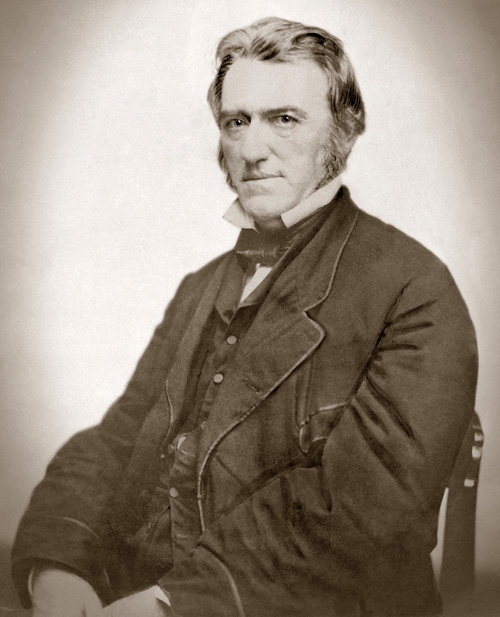
Leland Reid McAboy (1816 – 1885)
Dr. Leland Reid McAboy (1816-1885) was in fact a Democrat, like Dr. Mills, and was a Presbyterian minister who was, in turn, the son of a minister. He was born in the Ohio River city of Parkersburg, then in Virginia, and received his college degree at Ohio University at Athens. McAboy then received a Doctor of Divinity degree from Allegheny Seminary in Pittsburgh, where he was a classmate of Nathan Shotwell who also became a Presbyterian minister. Shotwell migrated South in 1859, married a Southern lady, and ministered at Rutherfordton as well as in a section of Rutherford County that was split off before the Civil War to form Polk County.
Reverend McAboy, in addition to holding a doctorate in divinity, was trained as a medical doctor, another point he held in common with Dr. Mills. So it happened that when Mills, the richest slaveholder in Polk County, decided during Reconstruction to sell his big plantation and move away, Shotwell stepped in to facilitate its sale to McAboy. His wife Mary Christy McAboy suffered from “consumption” and wanted to move to a milder climate. Her husband, by then a long-time respected minister in the Pittsburgh vicinity, had made a good deal of money investing in Pennsylvania oil stocks; in 1865 he had become a founder of Midas Oil Co. By August 1869, the North Carolina land transaction was consummated. Columbus Mills and his wife vacated their plantation and by the census of 1870, McAboy’s daughter and her husband L.N. Wilcox were living in Polk County.
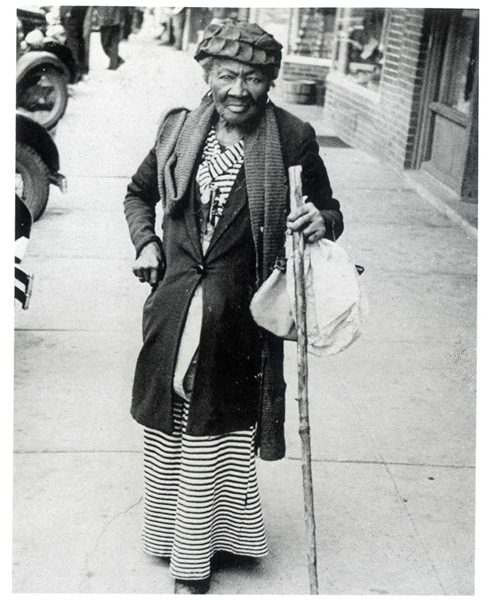
Delia Mills strolling Trade Street Tryon in 1939 — last surviving former slave from Columbus Mills plantation
It's fascinating to see the outcomes of the McAboy/Wilcox purchase in those census records. Delia Mills, a young black woman born on the plantation, was living on the date of the enumeration with the McAboy family in Pennsylvania. Meanwhile at the old Mills plantation, the Wilcoxes were hosting young Henry Bollman, the scion of rope-making entrepreneurs back in Pittsburgh.(It seems the Pittsburgh rope factories had lost their major raw material source in 1865 when slaves were freed in Kentucky, then the center of American hemp production. Hemp culture, however, subsequently failed to materialize commercially in North Carolina, so the Bollmans relocated their manufactory to New Jersey, where raw hemp could be economically imported from Europe.)
McAboy and Wilcox went on to experiment with other promising new crops in Polk County to replace earlier plantation agriculture that had so profitably employed enslaved black labor before the War. Ultimately labor-intensive fruit growing, especially peaches and grapes, proved the most successful. In 1875 a Charlotte newspaper humorously reported that Rev. L. R. McAboy had established a vineyard on Tryon Mountain (where pigs broke into his cellar, ruining 600 gallons of wine). About that year McAboy also became Polk County’s correspondent for the United States Agriculture Department in Washington. In 1875 his wife Mary was appointed postmaster of a new post office at the old Mills plantation. In 1877 the state senate appointed McAboy a trustee of the University of North Carolina.
While many of the Polk County land deals were in McAboy’s name, it seems much of the money came from Pittsburgh relatives of the old financial wizard Lemuel Wilcox the Elder and his wife Eliza Fleming—along with their son-in-law Frank Semple, a banker who for a quarter century was associated with the powerful Pennsylvania Railroad. Lemuel and Eliza’s son, Lemuel North Wilcox, had been raised in their Pittsburgh household that employed free black domestic labor. The younger Wilcox enlisted in a Union volunteer regiment that saw action in the South during the Civil War. Rev. McAboy contributed $10,000 cash to support Union recruiting efforts during the war, explaining “he was Southern by birth, but he was for his country, ready to offer his life, if necessary.” Thus these Pennsylvania “immigrants” were already experienced in navigating the complex cultural milieu of the Reconstruction South when they arrived in North Carolina.
Historians today are challenged to trace how development of the South’s railroads came to deploy controlling Northern capital during Reconstruction. Friendly Southern-born men were typically named officers and directors to mollify the locals. In 1871 a North Carolina legislative act named J.S. McAboy (a cousin of L.R. McAboy) as incorporator of a new railroad running through Polk County to connect Spartanburg to Rutherfordton via Columbus, the Polk County seat. It was never actually constructed; the nation’s sharp business Panic of 1873 kyboshed many such ambitions. A little later in the 1870s, however, an even more ambitious plan did come to fruition, the routing of the long-dreamed-of Spartanburg and Asheville Railroad—right through the old Mills plantation.

Lemuel North Wilcox, Union veteran
and surveyor of new Tryon City on his property.
On March 28, 1876, L.N. Wilcox and his wife, Anna McAboy Wilcox, signed an easement document granting right-of-way through their land for a new railroad ostensibly funded by South Carolina investors. It called for a depot, warehouses, engine sheds, workshops, a water station, firewood fuel sheds, and any other buildings or yards necessary. In 1877 L.N. Wilcox surveyed a new town, with named streets and named buyers of lots, and filed his plat with Polk County’s register of deeds. Annie Wilcox’s mother was given the honor of naming the town. Mary McAboy decided it would be “Tryon City.” The first train over the new rails arrived there June 11, 1877.
History buffs sometimes suppose the present US Highway 176 through Tryon follows the route of an early drover’s road, or that the early Howard Gap Road or some Native American path had something to do with the location of new 1877 Tryon City. Neither is the case. There was essentially nothing where the town came about, aside from farmland. It was sited for the railroad, the place selected for efficient routing of the rails gaining elevation from the South Carolina state line westward up into the valley of Pacolet River.
Some also mistakenly suppose the town was named to celebrate North Carolina’s colonial governor, William Tryon, and they’ve concocted scenarios telling he visited the immediate vicinity. But in fact Mary McAboy simply named the new rail town for landmark Tryon Mountain, clearly visible from the depot—a prominent landmark named long before in the governor’s honor in 1767 but one he never saw, much less visited.(Long before 1877, a post office some miles away, near Saluda, was named Tryon, for a district of Rutherford County, now in the western end of Polk; that post office also in view of Tryon Mountain was discontinued in 1878, when the rails reached Saluda.)

View published 1885 depicts old Mills Plantation house from Howard Gap Road.
From a cultural point of view, it’s fair to say that the McAboy and Wilcox estate centered at the old Mills plantation property became the “start” of Tryon as a later community. During the 1870s, its owners began receiving paying guests at the old plantation. McAboy’s bore little resemblance to a commercial hotel; it was more like a boarding house or “dude ranch” in character. Low-key and informal, there wasn’t even a reception desk. It had no central heating, no room keys, and no menu at table. There was no advertising nor listing in business directories of the era.
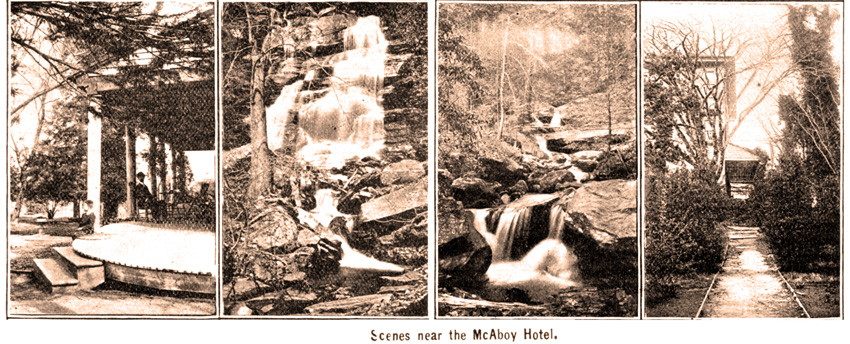
McAboy’s evolved into a resort rather organically. The big old house, built during Mills’s antebellum era, enjoyed a beautiful location. Most food was grown or raised on the property. Invitations to stay came about by word-of-mouth; paying guests were by referral. When the rails up from Spartanburg first reached the state line in 1876, guests could disembark from train cars and be met by livery conveyance to travel a short distance to the plantation. There typically they sojourned some days or even a few weeks. They might stay inside the old mansion, a simple cottage on the grounds, or even in L.N. and Annie’s comfortable new residence. Thus, when Baltimore professor Sidney Lanier, during his last week’s suffering of tuberculosis died in 1881 at McAboy’s, it was in the Wilcox house, not the plantation house. The poet’s wife, Mary Day Lanier, in an 1881 private letter to a Pennsylvania friend, tells that the locale was “strange” but doesn’t describe what made it so.
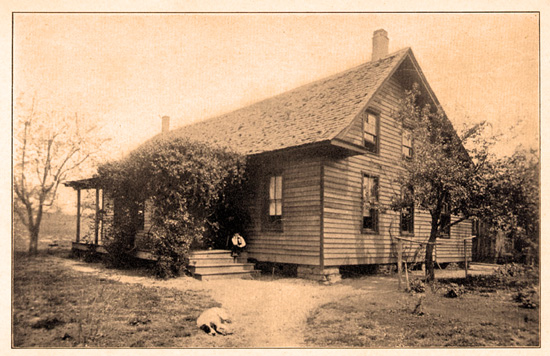
Wilcox cottage at McAboy’s, where Sidney Lanier died in 1881
Informality and unpretentious atmosphere clearly distinguished McAboy’s from most hostelries of that era. Northern visitors found the place intriguing and they could journey out for day trips to several waterfalls and horseback rides in nearby “wilderness.” We know too, for example, that Southerners, such as newlyweds James and Ada LaRoche, stayed for summer sojourns. (LaRoche, a twenty-five-year-old teacher at Claflin College in Orangeburg, SC, came with his bride in 1880. Claflin, founded by New England sponsors, educated black people; Ada’s father, William DeTreville, was a mathematics professor there. Ada LaRoche died the following year; her husband became an Episcopal priest.) Another guest that summer was white Presbyterian minister John M. Hastings, whose long-time pastorate was near McAboy’s own in Allegheny County, Pennsylvania. Hastings’s unmarried son stayed under the same roof as the Wilcoxes, while black Delia Mills—now 28—resided in Rev. Hasting’s cottage.
Irascible author Solon Robinson sojourned at McAboy’s. Famous nationally for his 1853 novel Hot Corn (so racy that young Henry James wasn’t allowed to read it), Connecticut-born Robinson had mellowed and was now editing American Agriculturist and writing features for the New York Tribune. Agriculturist Elbert S. Carman was another McAboy’s guest. As publisher of The Rural New Yorker, he was recognized nationally for his vigor and integrity. A 19th century biographical profile says of Carman, “His detestations of sham and fraud are intense and ever active.” Our picture of old McAboy’s suggests a gathering of personalities who were unusual and even, as Mrs. Lanier told, sometimes “strange.”
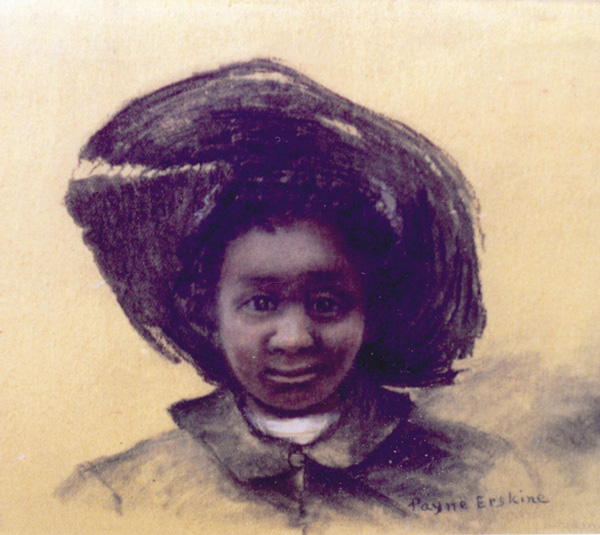
a Payne Erskine 1885 portrait of a child at McAboy’s
Unconventional writer and painter Emma Payne Erskine from Wisconsin first visited McAboy’s in 1885, finding she greatly preferred its atmosphere to swank Pasadena in California that she and her industrialist husband could well afford for winter vacations. She spent happy hours painting portraits of black children who lived at the old plantation, the earliest known North Carolina paintings that depict Blacks without condescension. Not long afterward, she and Mr. Erskine decided to construct their winter estate nearby and became social pillars of the new town. Her father Alfred Payne, professional artist from Chicago, visited and became one of many well-connected people from America’s metropolises who spread the word of the beauties and pleasant tone of Tryon City’s vicinity.
During the 1880s, the community at McAboy’s attracted many more, some who, like the Erskines, settled permanently at Tryon City. The village became a magnet especially for thoughtful people who came to do good, as well as to “be themselves.” It was incorporated in 1885, an attractive new hillside hotel was constructed above the first Depot, and in 1891 its name was shortened officially from Tryon City to Tryon.
Michael McCue
May 31, 2023