
Monster Freight Locomotives for Saluda Grade

Railroad through mountains near Saluda. Photo by Scott Park courtesy Upstate Forever.
Nobody in the Roaring Twenties foresaw that, some two decades hence, diesel engines would replace coal-fired steam locomotives for pulling heavy freight trains over the Eastern Continental Divide. For fifty years after the steep route through Polk County was completed, from Tryon over the Blue Ridge, Southern Railway’s analysis repeatedly rejected any alternatives to relocate the railroad line or to build tunnels. Steam technology had always gotten better and better. Locomotives got bigger, heavier, and ever more powerful. SR’s management took great pride in competing with America’s other important railroads to bring out new generations of locomotives more technologically impressive and efficient, capable of pulling longer freight trains at greater speeds over mountains.

1926 prototype, Southern Railway 4050
Eight locomotives built in 1928 for Saluda grade had even bigger fireboxes and tenders.
Photo collection Harold K. Vollrath
With a maximum grade almost five percent, its Saluda Grade was explicitly in mind in 1926 when SR commissioned Baldwin Works in Pennsylvania to build a new class of freight locomotive. Predecessor was the Ls-1 class Mallet, a monster with two engines. A rigidly-mounted engine by the engineer’s cab produced high-pressure steam for eight drive wheels beneath. Forward of that on a separate swiveling truck, another engine took steam from the high-pressure engine, to power eight more drive wheels on the rails. This arrangement was the ”articulated” 2-8-8-2 design. (The 2s were non-driven wheels upon the rails, to stabilize the massive weight of the entire locomotive.) Long articulateds could more easily negotiate curves and not derail on tracks less than perfectly maintained. Both weighty engines, roughly center-mounted on their four driving axles, distributed weight evenly for adhesion to the steel rails, and had enormous horsepower. The prototype, SR locomotive 4050, pulled 16 tons of coal and 10,000 gallons water loaded in its huge tender.
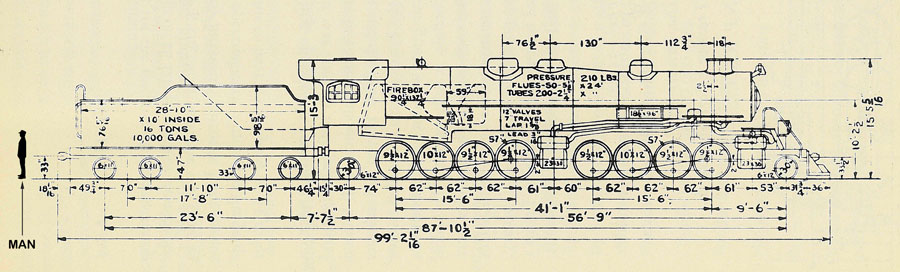
Edwin P. Alexander (1905 – 1981) was a scholar and enthusiast of rolling stock, designer of kits to build scale models and “Father of American Model Railroading.” His visits to Baldwin Works and friendship with C. C Elms, head of the Erecting Shop, enabled Ed to create dimension sketches like this one of Southern Railway’s 2-8-8-2 locomotives. Their production drawings were destroyed.
Key to this new generation technology was the Superheater, to convert wet steam to “dry steam.” (Superheaters are still used today, throughout the world, in conjunction with steam turbines in electric-power generating stations.) Baldwin deployed long pipes placed inside larger-diameter fire tubes, called flues. Hot gases from the firebox pass through the flues and, as well as heating water in the surrounding boiler, they heat the steam inside pipes they flow over. A superheater element doubles back on itself so dry steam can return into a separate compartment, then pass to engine cylinders.
Baldwin’s design proved out in test. In fact the 4050 prototype operated successfully over mountain rails for more than two decades. Proud SR management announced their new Ls -2 series and ordered eight more, fabricated at Eddystone, PA and delivered to Southern Railway in 1928 with more upgrades.

Famed industrial photographer Lewis Hine (1874 – 1940) was working for the WPA when he visited the massive Baldwin Works, to create this image of a skilled machinist planing castings for a locomotive frame. This employee at Eddystone, Penn. was one of the workers who built SR freight engines used in Western North Carolina mountain service.
The Ls-2 tender, welded instead of riveted, came with water capacity of 14000 gallons to minimize water-stops between Asheville and Spartanburg. Firebox combustion area was upgraded to 436 square feet. Thermic syphons were added to enhance the firebox contribution to overall heating efficiency, for fuel savings. Boiler pressure was 210 pounds per square inch, with exhaust steam injectors. Superheater area was increased to 1420 feet. Both engines were hinged together under the boiler with the pressure vessel itself attached directly onto the frame of the forward engine, hinged to swivel semi-independently. Each cylinder was 23 by 30 inches, piston valves 12 inches. These locomotives numbered 4051 to 4058 operated over SR mainlines for heavy freight until 1951.
With tenders 29 feet long, they were nearly 100 feet in total length. Tops of the cabs projected more than 15 feet above the rails. Each Ls-2 weighed 660,400 pounds, but careful design over the sixteen 57-inch drive wheels spread the massive weight evenly to reduce wear on the Southern’s steel tracks. Used exclusively for freight operations, they were sights to behold with long trains behind them, huge plumes of black smoke emanating. Besides the roar of both engines and sounds of churning pistons, the shriek of their warning whistles was deafening.

Ls-2 steaming past Saluda depot March 21, 1938
photo by William Franklin Clodfelter (1911 – 1984)
During the Great Depression, freight trains became avenues of travel for those out-of-luck. Escapees from Polk County jail headed to the rails. One day the publisher of Tryon Daily Bulletin counted sixteen transient visible hoboes riding boxcars of just one train. Local boys with no money jumped on for free fare too, but some weren’t so lucky and lost a foot or leg under fast-moving wheels. In 1937 editor Vining reported how three bootleggers, too much in a hurry, lost their car when it collided with a freight at a back-street crossing in Tryon. Auto drivers of all kinds became impatient with long freight trains stopped to allow passenger trains priority at Tryon depot, which would block the Pacolet Street and Newmarket Road main intersections. During World War II, freight train frequency through town increased even more. Constant shrieks of the freights’ whistles caused many complaints.

Clipping from Tryon Daily Bulletin humorously reports 1937 news of bootleggers’ car demolished by encounter with freight locomotive. Locally-produced wine was legal to buy at that time, but not their ten gallons of moonshine discovered in the wreck.
Derailments had always been bad for Southern Railway public relations, and there had been plenty. But in 1940 occurred the worst event of all for the monster class Ls-2s. On September 25, Engineer A.D. “Turk” Pope out of Inman, SC lost control of his Ls-2 number 4052 at 5:45 a.m. coming down steep Saluda Grade. His consist was an empty flat car, empty oil tank, refrigerated fruit car and some loaded coal cars. The runaway train was spotted in time to switch it to the #1 safety track 1080 feet long up steep grade. It shot up the mountainside, but momentum was so great the 100-footer ploughed through the big earth mound at the end of the safety track, through anchored timbers chained to the rails, and plunged down a ravine a hundred feet. Its cowcatcher was buried in the dirt. The heavy coal & water tender in the rear was reported thrown almost straight in the air, burying the fireman in an avalanche of coal. He was taken out dead. Force of coal cars behind was so great that when the LS-2 plunged the empty flat car next behind it turned cross-wise, its thick steel beams twisted and broken like twigs. It and the oil tanker were the only cars actually to derail. A temporary side track was built in the aftermath, as it was thought two cranes would be needed to pull the wrecked 660,000 pound locomotive and tender out of the ravine.

Photo of the 4052 locomotive which crashed in 1940 in Polk County, new in 1928 when it departed the Eddystone, Pennsylvania works for service on Southern Railway.
Engineer Pope and his brakeman jumped out of the cab to save their lives while it was still on the safety track. James Williams from Morganton, a Navy veteran and the fireman in the tender that morning, lost his life in a scenario similar to that which killed Casey Jones the railroad legend. Williams decided to stay with his train and to trust the earth mound to stop the Ls-2. But the coal stoker was killed when coal from the tender massively slid into the locomotive cab. He left a wife and three children. Williams’s fate became part of a Southern Railway training film for Saluda Grade service. His 1940 death was the last crew fatality in railroad service on that stretch during the age of steam.

Wrecked Ls-2 number 4052, photo 1940 by Frank Clodfelter
The year 1940 was important in rails history, for that year almost 500 diesel locomotives were ordered by America’s railroads, though manufacturing capacity to build them wasn’t yet sufficient to deliver them. During World War II, orders for diesels skyrocketed and USA coal production was rationed. By 1946 orders for steam locomotives had declined to a trickle; in '47 just 79 new ones were ordered while 2149 diesels were wanted immediately by the railroads. Liquid fuel for them from American petroleum refineries became readily available, and fuel quality became standardized.

Early diesel locomotives weren’t powerful enough to pull SR’s freight trains up the Saluda Grade. So steam locomotives remained in service several more years. When its first diesel pulled a train through Tryon it was limited to 1500 tons. For longer and heavier consists the trains required a steam helper engine kept at Melrose, to push from behind. It was only in the 1950s that multi-unit diesel engines were able to “go it alone” up to Saluda. Southern Railway last used Ls-2 monsters through Saluda in 1943, when they were transferred away to pull unit coal trains for the war effort. All eight of these memorable locomotives were scrapped in the Fifties.
In 1950 some 41,000 steam locomotives remained in service in the United States. Edwin P. Alexander, historian and expert, wrote that year “to replace them will be lengthy and costly, they will be seen on our railroads for many years to come. Some will be built by roads serving the major coal fields. Experiments are continuing with gas turbine power using pulverized coal, but conclusive results are not yet available. Electric power and traction might be expanded – such locomotives by actual comparative tests are ahead of steam and diesel engines on most counts –although increased use is not particularly indicated at present.” His 1950 book American Locomotives extolls the Chesapeake & Ohio’s 4-8-8-4 turbo-electrics, the longest such locomotive ever built at 154 feet and the heaviest as well. Built at Baldwin Works and nicknamed the “Sacred Cow” its tender carried only water, 25000 gallons. Coal load was 29 tons on-board that behemoth; a mechanical stoker fed the fuel to a conventional firebox and boiler, then a turbine powered two electric generators driving eight axle-hung 580-Volt motors. Obviously in hindsight this technical wizardry didn’t prove practical.

Southern Railway’s monthly publication Ties for rail enthusiasts, February 1950, shows new four-unit diesel engine towing a long freight train at Melrose. A steam-locomotive is depicted as “gone away” from their freight operations. The feature emphasizes dynamic braking of diesels for safety on downgrades. “Diesels on Saluda provide additional evidence the Southern is maintaining its leadership in progress.”
Because passenger trains are lighter and shorter, steam locomotives were used longer through Polk County.The public started to appreciate the old steam-engines pulling passenger trains. Their infrequent, more cheery whistles became a “retro” reminder of an era folks realized would pass. Meanwhile the dull roar of oncoming diesel freights became a menace; lives were lost when people failed to hear their approach at grade crossings. That problem continued after SR lost post office mail contracts and its passenger service finally was discontinued in 1968 through Saluda and Tryon. The Southern merged with the Norfolk & Western Railway in 1980. Freight use of rails through Polk county ended in 2001.
Mike McCue December, 2025


Questions or comments? Get in touch:
TryonHistory.org publishes original essays pertaining to Polk County, North Carolina before 1999. We’re not a history museum or archive, and we don’t conduct historical research for individuals or organizations.
-
111 Kangaroo Drive
Columbus, NC 28722
- (828) 436-2102
- info@tryonhistory.org
- © Condar Press. All rights reserved.