
Rare Scenes of Real Life
Many historians seek pictures showing how most people actually lived. Not the rich, not the famous. Places that weren’t glamorous. Activities rarely photographed. They’re hard to find, but they exist. Occasionally a family snapshot album will turn up something “vernacular” that’s unusual. Another potential source for rare scenes of “real life” is old school yearbooks. We present here nine unusual old photos selected from the Tryonite, the combined 1961 yearbook of Tryon High and Tryon Elementary School. Among hundreds of images, most of them delightful but predictable, these offer us authentic views published nowhere else. Although these scenes aren’t necessarily pretty, they were printed surprisingly well by an uncredited publishing house. In no instance, either, do we have a photographer to credit. All these vintage images are, therefore, in the public domain. They may be shared, studied and reproduced by anyone to learn what non-verbal primary sources can tell us about the past.
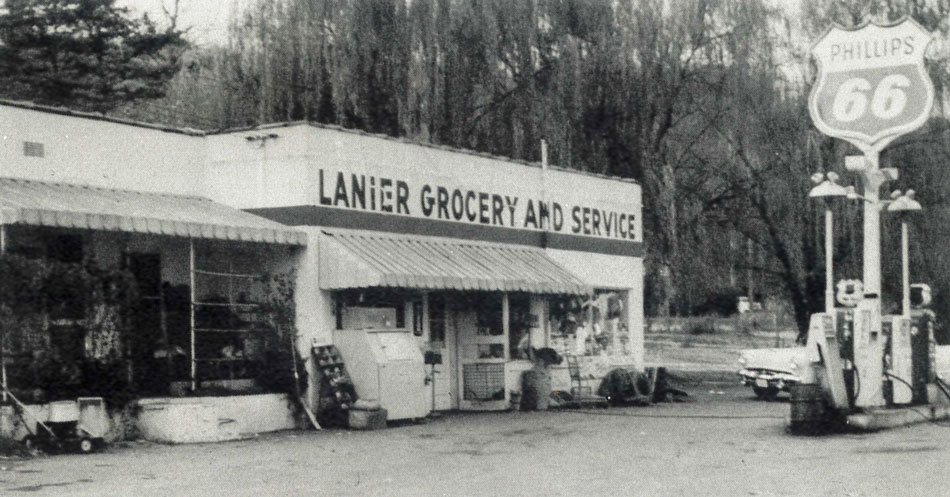
Paid ads by local advertisers offer us some of the most intriguing pictures. Lanier Grocery and Service is an example. A typical American roadside general store of that era. On US Highway 176 near the state line, an independent family-owned business “across from the drive-in theatre, open till 9 p.m. every night and all day on Sunday.” Unpretentious and, frankly, not very spiffy. What today’s historian relishes is how this photo isn’t condescending and it isn’t patronizing – after all, the owners paid for their half-page ad. Had they disapproved of this scene, it wouldn’t have been published. So this is as real as it gets. Sincere, documentary.
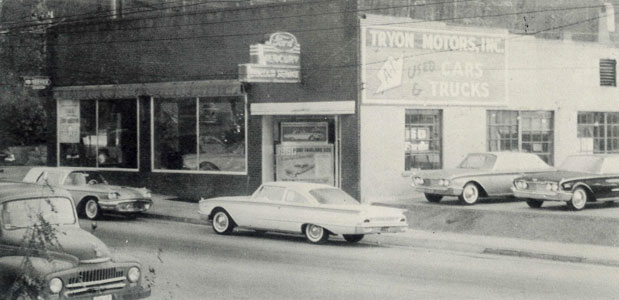
An advertisement by Tryon Motors, Inc. depicts their showroom and garage, a 1960 Ford Fairlane Club Sedan parked out on the street. With whitewalls and tasteful fins, that two-door was a high school boy’s new-car dream. Buyers could choose the three-speed or a Fordomatic. An inline-six produced 145 h.p., the 4.8 litre V8 put out 180 h.p., or the 312 (5.1 litres) got you 245 h.p. for awesome acceleration and a thrilling drive. Seat belts and outside rearview mirrors were, of course, optional. We see a T-Bird there, too, and a new Mercury. Realistically, the big sign invites you inside to look at A-1 Used cars and trucks.
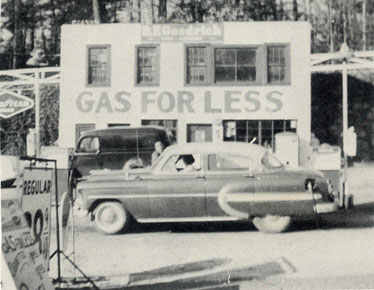
Gas for Less Service Station is the rarest of these pictures. By 1961, America was the Nation on Wheels and anybody who wanted one had a driver license and something to drive. This shows an ordinary eight-year-old Chevy gassing up at 28.9 cents per gallon of leaded at “Booger” Ford’s place. Beyond is an ordinary drab delivery vehicle from that era. The building’s still there today, renovated many times, on Trade Street heading to South Carolina just past where it crosses the railroad track, west side on the right.
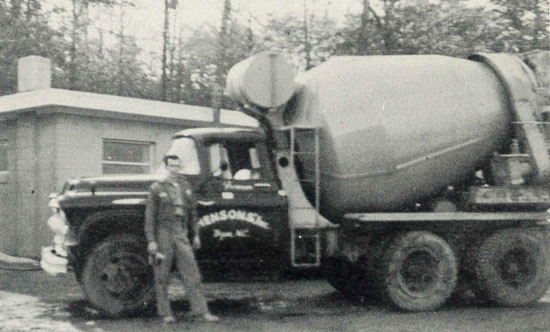
Heading that way you came to Ridge Road by the state line. Henson’s Inc. ad shows their concrete mixer truck. They did grading and hauling too. At one time 20% of Polk County’s workers were employed in the construction sector, a major business. People and industry were relocating to the South in droves, building new homes and factories, offices and stores, schools. During the Fifties and Sixties, Polk’s economy shifted rapidly away from agriculture toward manufacturing and services, in step with national trends.
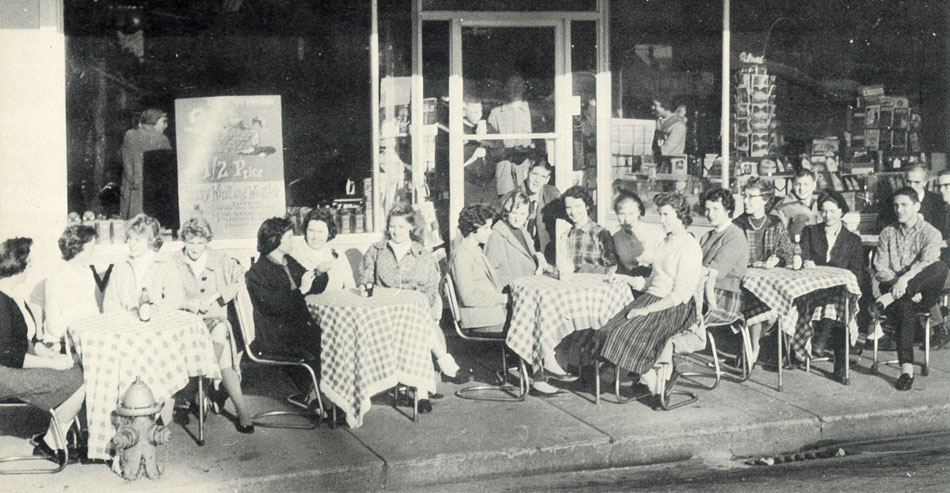
At Tryon School the most popular foreign language courses were in French — more than Latin, German or Spanish — a tradition that went far back to Tryon’s early days. Its early private schools emphasized French; Miss Fassett’s at Pine Crest required immersion in that language beginning in the first grade. Tryon’s most famous native daughter, Eunice Waymon, excelled in French and got straight A’s in it at Tryon Colored School; as musician Nina Simone she lived in France and died there in in 2003. In this picture from the 1961 Tryonite we see members of Le Cercle Francais at tables set up outdoors on Trade Street as though they were socializing at some French sidewalk café. (It appears girls are fluent in their roles, while the French Club boys may not be sure what they’re supposed to be doing.)
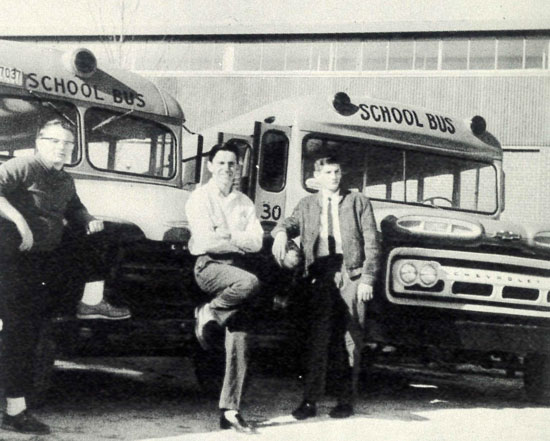
Most kids walked to school, but for pupils from longer distances two school buses offered a ride. Rides were a privilege and not a right. Should some kid act up or give lip to Mr. Bruce, Mr. Williams or Mr. O’Shields, the bus slowed to deposit the lad by the side of the road.
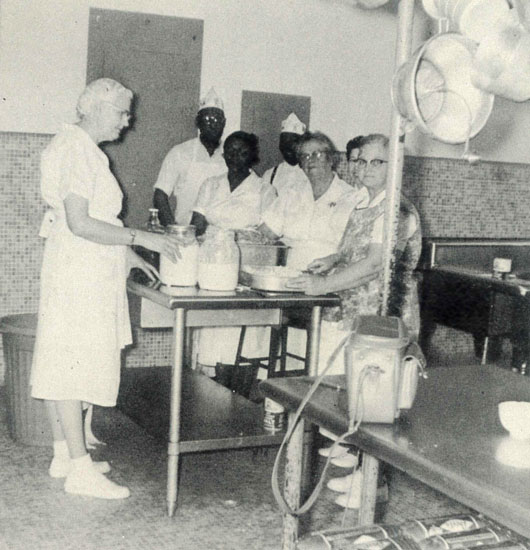
A cafeteria fed students who didn’t carry their own food to Tryon School. This rare photograph depicts the mixed-race staff of food-service professionals, three of them the only Black faces seen in the 1961 Tryonite. (It was seven years after the Supreme Court’s Brown v Board of Education landmark ruling and four years before Polk County schools finally were integrated.) They’re identified as Otha Johnson (1914 – 1984), Estelle B. Howard (1909 – 2000) and Leonard Charles Copeland (1934 – 1974). Otha and “L.C.” were real characters, Mr. Johnson particularly a skilled comedian. Mrs. Howard was especially skilled at cuisine; she masterminded the impressive meals sold at St. Luke CME to help pay for their new brick church building. During the process of school integration the lunchroom became the flashpoint of hurt feelings; how come it was okay to eat there, but not along with the children of people who made and served the food?
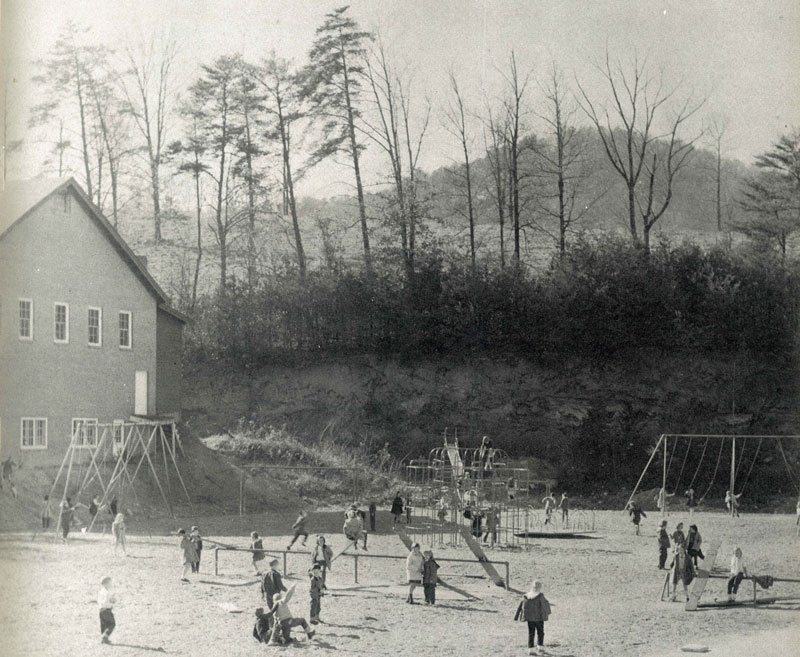
Within sight of the spacious school playground were residences owned by Black people, whose children by law were required to attend a segregated school on the other side of Tryon. In this 1961 scene white kids enjoy use of its excellent equipment. Ironically the old gymnasium is seen here where competitive inter-district basketball games were played, by separate teams from the white and black Tryon schools. Harthorne Wingo (1947 – 2021), who played on the integrated Tryon team a bit later, went on to play pro including four years with the New York Knicks. It was proposed to name the old Tryon gym for that Black athlete after he retired, but decision-makers decided to raze the venerable brick gym; instead a plaque honoring Mr. Wingo was installed on Trade Street.
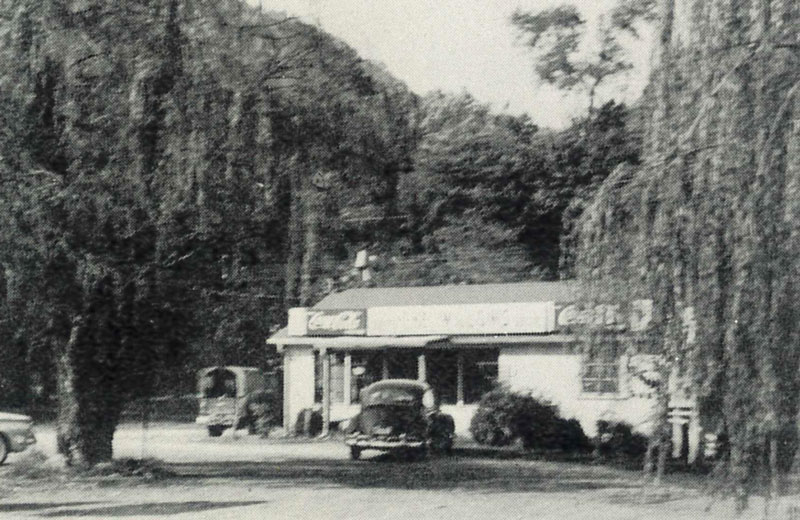
Out US Highway 176 in Pacolet Valley was The Willows café owned by Harold & Bessie Nessmith. Their ad in ’61 includes a rare photo of their establishment. Appropriate to the scene is a VW Bug parked in front – and probably maintained at Edney’s Garage, just up the road, which specialized in those imported cars as they became enormously popular with young people, artists and creative folks of all kinds. The Willows was a casual spot favored by high schoolers for socializing.
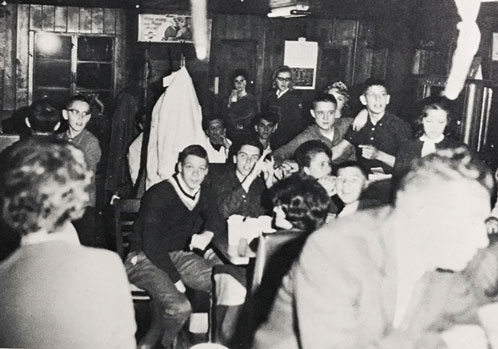
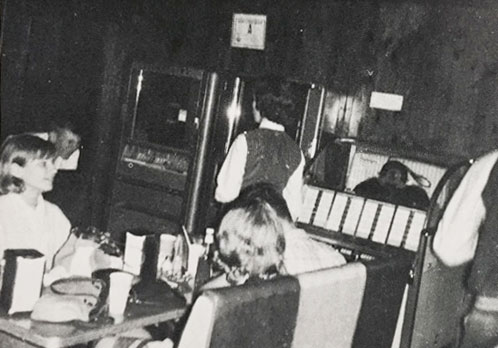
Linda Merrick was an eighth grader at Tryon School in ’61, daughter of a Tryon mayor and granddaughter of Anson A. Merrick, civil engineer educated at US Naval Academy in Annapolis and early Town Manager. Now a resident of Gaffney SC, Linda has rustled up two delightful Sixties photos taken inside. There’s a juke box, chrome dinette booths, young people enjoying the wood-paneled hang-out. It was safe, alcohol-free, and a little rowdy at times. Parents at home could feel comfortable their under-age kids were all right with the Nessmiths at The Willows “Home of Good Food in the Valley.”
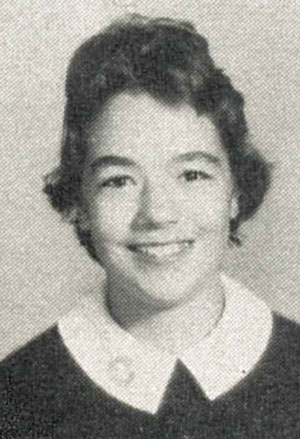
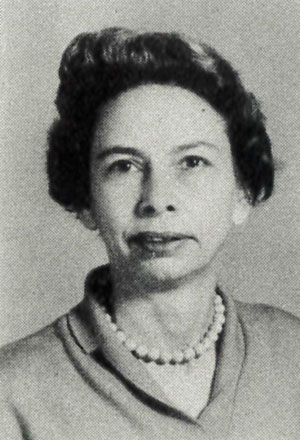
Linda’s teacher in 1961 was Lois Smith Beatson (1919 – 1986) who taught in North Carolina public schools for 42 years. A graduate of Asheville Teachers College, we have “Delle” Beatson to thank for preservation of her 1961 Tryonite containing these historic images and many more. The yearbook is archived now at the Green Life Inn at Mimosa, Lynn NC.