
Tryon's Woodworking Traditions

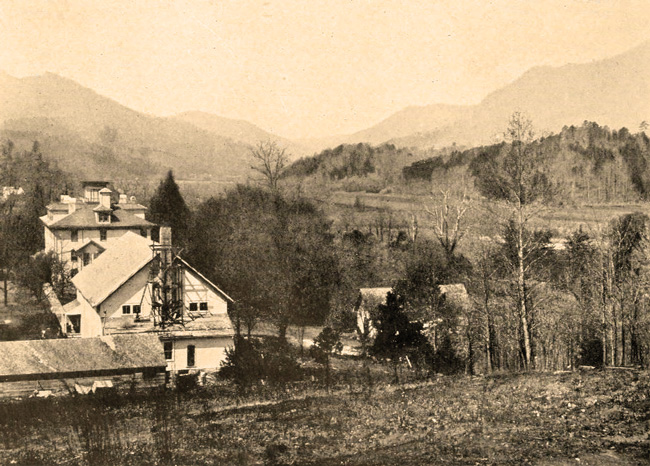
R.H. Scadin, 1897
New Tryon Depot,
toward Tryon Peak and White Oak Mountain
R. H. Scadin Collection #rhs0345, D. H. Ramsey Library Special Collections, University of North Carolina at Asheville.
From the town’s founding in the 1870s, local virgin wood resources shaped its culture and enterprises. An unusual diversity of hardwoods was discovered by botanists in glens and mountain slopes, attracting scientists to study its mixture of trees typical of higher elevations and more northerly latitudes along with species found more often further south.
Botanists such as Cornell-trained Charles Frederick Millspaugh (class of 1875) of Chicago’s Field Museum, were attracted to the vicinity for field study. He and others from the Midwest and Northeast sent the nation’s herbariums and arboretums specimens, attracting more amateurs and professionals who could access Polk County’s relatively unspoiled forests after the railroad from Spartanburg, S.C. reached new Tryon City in 1877.
Immediately after the rails reached Tryon, specialty manufactories were established to exploit valuable hardwoods. Spokes for wheels, broom and tool handles, and roofing shingles were already being produced before Tryon City was incorporated in 1885. Investment capital from Pittsburgh entrepreneurs proved readily available and management talent came in from the North. Indeed one of the original Town commissioners was Edwin Anderson from Oneida County, New York. He received a US patent for improved machinery to produce vast quantities of roofing shingles, usually from red oak, to be shipped out by rail.
Estabrooks Park from Tryon, N.C.
A view of the park in the left middle ground from one edge of the town. The approach of the town to it added somewhat to the increase in its value.
American Forestry magazine, 1915
Silviculture, the replenishment of cut-over forest, was pioneered at Tryon as well. Gifford Pinchot from Pennsylvania and Carl Schenck from Germany, working for G.W. Vanderbilt at Biltmore Estate near Asheville, weren’t the only men experimenting with methods to “farm” the Southern Appalachians with new trees. In 1889 John Albert Estabrooks, an 1873 Harvard College graduate and Boston entrepreneur, visited Tryon on holiday. In 1894 he purchased a cut-over tract of steep land near Tryon, to experiment with selective silvaculture. In 1900 Frances Wright, a Northern botanist herself and president of Tryon’s Lanier Club, read his paper to a club meeting and North Carolina’s state forester made Estabrooks’s work an exemplar of how such management could practically be implemented. The project was featured in American Forestry magazine in 1915, citing a local “mountaineer” who called Estabrooks’s 36 acres “the best stand of trees in Polk County.”

Ralph Erskine
Much virgin forest remained in the area after 1900, as landowners learned how selective cutting and intentional replanting was more profitable than clear-cutting. Ralph Erskine, scion of a prominent Wisconsin family who was educated at Williams College in the Berkshire mountains of Massachusetts, began his Tryon Chair Factory near the Erskine winter estate, in the old Ballenger mill near Tryon. Inspired by the Arts & Crafts movement, his enterprise pursued chaste design and quality woodcraft. His marketing emphasized inspiration from old “indigenous” Southern handcrafters of “primitive” furniture for local consumption, though truth-be-told Erskine deployed modern machinery. Walnut, sweet gum, and other woods from the area were Erskine’s raw materials.
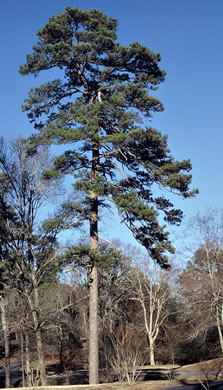
mature Pinus echinata
photograph courtesy Richard & Teresa Ware
As Tryon emerged as a nationally-significant artists colony during the early 20th century, painters and art-photographers took to celebrating Pinus echinata as its iconic tree. This picturesque pine isn’t especially prevalent in the virgin forest landscape, but the species was often left present after logging because its wood has no particular commercial value. Its cones and branches present especially striking silhouettes, esthetically appealing in landscape scenes. Tryon author Margaret Morley’s 1913 book The Carolina Mountains helped popularize its common local moniker “armored pine,” for the peculiar slabby bark pattern which an observer can imagine looks something like a medieval knight’s grey body armor.
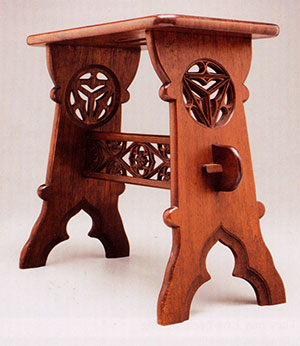
Tryon’s most famous woodcrafters were the Tryon Wood-Carvers, part of an enterprise started in 1915 by Eleanor Vance and Charlotte Yale, earlier instigators of Biltmore Estate Industries in Asheville. Vance was a graduate of Cincinnati’s art academy school, America’s outstanding training ground for woodcrafts as fine art. She had gone on to England for advanced training. Vance’s designs often deployed Appalachian motifs, but the execution was European and world-class. Small exquisitely hand-carved fireplace bellows, picture frames, bookends and so forth were sold from their retail Toy House, designed in a European cottage style by architect J.F. Searles in 1925, and in high-end department stores of America’s big cities. The Wood-Carvers also executed elaborate custom-designed projects, major furniture and even doors and paneling, for clients from far away. National magazines lauded their work. Allen Eaton’s landmark 1937 volume Handicrafts of the Southern Highlands depicts their commissioned door for a mansion in Washington D.C., though their sophisticated designs often didn’t really fit his theme of replicating so-called “indigenous” or “authentic” Appalachian craft.

Madison Geer’s woodturning class at Tryon Arts & Crafts School.
During the 1920s and ‘30s more first-class woodcrafters settled in Tryon. Frank Arthur, son of Scottish parents and trained by Vance at Biltmore, set up his own wood studio and teaching atelier, in another picturesque Searles-designed structure which evokes British antiquarianism. Rolla Dyer, an Episcopal priest from Ohio, established his workshop nearby to make violins. Tryon Crafts, an association of amateurs and professionals, was formally established after World War II to nurture creative expression in wood and other media like fiber and ceramic. This organization continues today as Tryon Arts & Crafts School, its wood studio at their Harmon Field Road campus -- near where Ralph Erskine was expertly crafting high-quality product from local woods a century earlier.
Michael McCue
March 15, 2023