
Schweikher's Modernism: Edward Bennett Estate

From the Hunting Country Road a narrow half-mile drive led elegantly through meadow and wood to reach a striking residence designed for Edward H. Bennett (1874-1954), prominent urban planner. Though trained at the École des Beaux Arts, and designer himself of such rigidly formal landscapes as Denver Civic Center, the 1933 Chicago World’s Fair, and Federal Triangle in Washington, Bennett’s personal tastes were catholic. He enjoyed painting limpid abstract landscapes and designed landscape of this rolling equestrian estate in a naturalistic manner, gently working the topography and incorporating an earlier rustic barn with groom’s quarters. Though British-born Bennett designed his own Chicago residence as a dignified 18th-century French manoir, for his Tryon residence he chose much-younger Modernist architect Paul Schweikher (1903-1997). A native of Colorado whose ouevre draws on the Prairie and Bauhaus schools of design, Schweikher went on to head the architecture departments at Yale in 1953 and at Carnegie in Pittsburgh in 1958.

Edward Bennett watercolor 1939
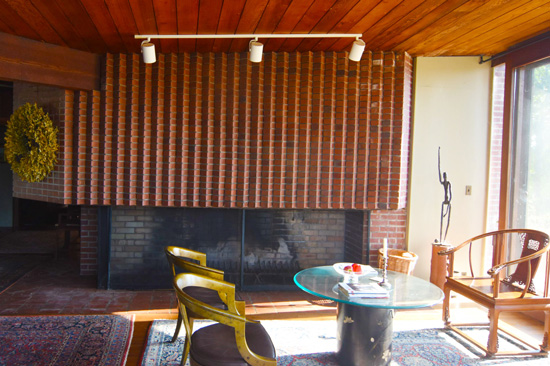
Similar to that for Schweikher’s own Illinois home, this massive fireplace was detailed in native stone by young draftsman Holland Brady, working in the architect's studio outside Chicago, in 1949. It was actually executed at Tryon with warm brick used elsewhere in the house. Then a recent graduate from University of Michigan's architecture program, coincidentally Brady was a Tryon native. Soon after drafting this fireplace for Schweikher, Brady moved back to North Carolina. He later designed a compatible Modernist guest house for Bennett's estate.

Offered for sale in 2019 after the deaths of later owners from Illinois, the estate's buyer chose not to keep the 3,000 square foot residence.

Intersecting boards give illusion of ridge or mitre; ceiling is actually one plane. This clever feature was extolled when Schweikher’s Tryon opus was portrayed in a 1952 issue of Architectural Record.
Fans of Robert Paul Schweikher’s architecture recall his outstanding Modernist work shown at New York’s Museum of Modern Art in 1933, as well as his innovative designs shown at Chicago’s Century of Progress International Exhibition. He studied a year at University of Colorado before moving in 1922 to Chicago where he studied at the Art Institute and Armour Institute. He got his architecture degree from Yale, then returned to Chicago in 1930 to collaborate with famous designers Philip Maher and George Fred Keck. During the Thirties he designed Third Unitarian Church (a listed Chicago landmark) and the Redwood Village Cooperative in Glenview. By 1949 he’d already designed the memorable Lewis, Burda and Berg residences in Illinois and the remarkable Upton house (later destroyed) in Scottsdale, Arizona.
Tryon’s equestrian scene took off after the second world war, becoming a nationally-known magnet for horse-lovers that culminated in the Olympic Trials, which took place there in 1956. During that period people like Edward Bennett and his wife invested heavily to improve their estates in Hunting Country. The Bennetts’s had beautiful views of the mountains. Schweikher’s assignment for his sophisticated client was to create a unique residence to take advantage of the views, fitting the land without dominating it and designing comfortable, intimate spaces for entertaining and for relaxing in total privacy.
Like other Modernist homes of Mid-Century, the Bennett commission deployed full-height windows in public spaces, from floor to soaring ceiling. The roof pitched in a single plane upward from the public entry façade – which had no glass at all, except in a dining area by the entrance carport.
The unusual carport facing Bennett’s entry driveway was formed by an eighteen-foot roof extension over a parade of angled brick pylons.
The bedroom wing had ribbon windows oriented toward the mountain view. Kitchen, laundry and maid’s suite were in the service wing angled to be invisible from bedrooms, public areas and arrivals in the motor court. Photographs presented here record the residence as viewed during the public estate sale just before the property was offered for sale in 2019. Other images exist in a 1952 feature in Architectural Record magazine that made this Schweikher design nationally known.
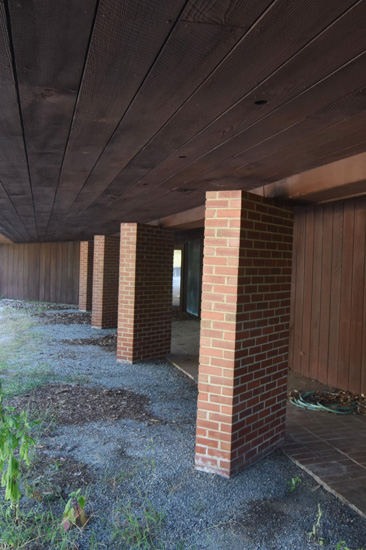
A parade of monumental brick pylons support roof for sheltered parking.

Hallway from public spaces to private quarters.
The architect served in the Navy during the world war in the South Pacific, after broadening his design horizons with travel to Mexico and elsewhere in Latin America. In April 1947 the entire issue of Nuestra Arquitectura was published in Buenos Aires featuring Schweikher’s designs. In Japan he made a special study of domestic architecture. Connoisseurs of American design history enjoy observing influence of ancient and contemporary architecture from the Orient and the Occident which made Schweikher’s design for the Bennetts in Tryon so uniquely special.
Photographs courtesy Litchfield Carpenter
Learn About Tootin' Hill
