
The Dying Writer’s Final Work: Sidney Lanier in North Carolina
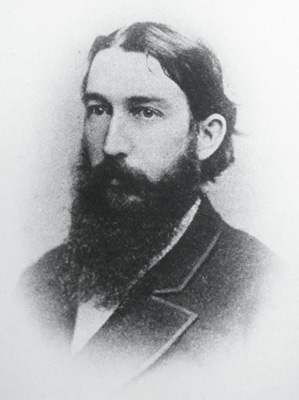
Today remembered chiefly as a famous poet, Lanier before his death at 39 – at McAboy’s resort near Tryon - was known for other reasons as well. An accomplished flute musician, he composed music and performed as virtuoso soloist in New York City. Lanier was hired for Baltimore’s Peabody Orchestra, where he came into the inner circle of the Maryland city’s intellectual elite. He composed lyrics, sung by 800 voices, for Dudley Buck’s grand cantata performed in 1876 at the inaugural of the nation’s Centennial exposition at Philadelphia. A native of Georgia and Confederate veteran, Lanier wrote eyewitness travel works about Florida and Texas. He self-published a novel about Reconstruction. For Lanier poems were just one creative interest, especially their tone and meter which he liked to relate to music. In Boston he met poets Longfellow and James Russell Lowell who found the young man charming, earnest and interesting. But Lanier didn’t presume it feasible to support his family by poetry.
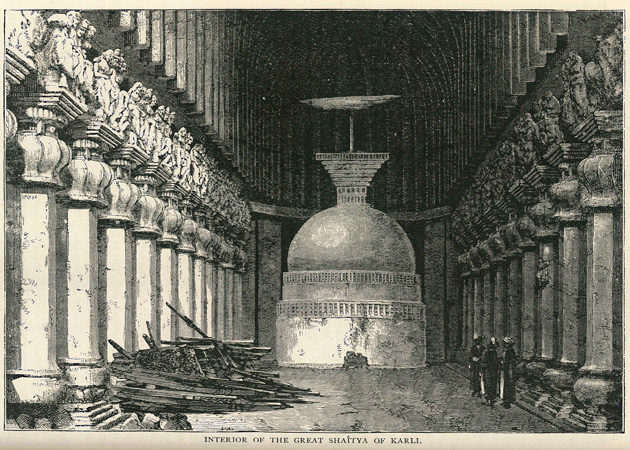
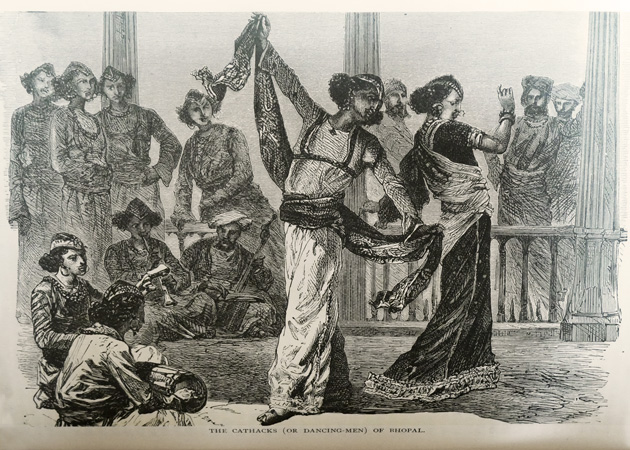
In 1876 John Foster Kirk, editor of Philadelphia’s prestigious monthly magazine Lippincott’s, decided to publish a selection of vivid images of India originally created in France. Kirk himself was a broad-minded scholar of foreign cultures and history. His national audience was keenly interested in world travel and in issues of religious diversity, morality and socio-economic progress. French, and later British, books with these unusual images of India had appeared but their written commentaries didn’t appeal to Kirk, so he turned to young Sidney Lanier for new commentary. His author wasn’t credited during Lanier’s lifetime. Some of the French pictures were “edgy” and even scandalous. Sidney’s ekphrastic essay takes the form of a “travelogue” written by an ordinary fellow witnessing strange and surprising scenes in that complex society, not at all familiar even to well-traveled Americans.
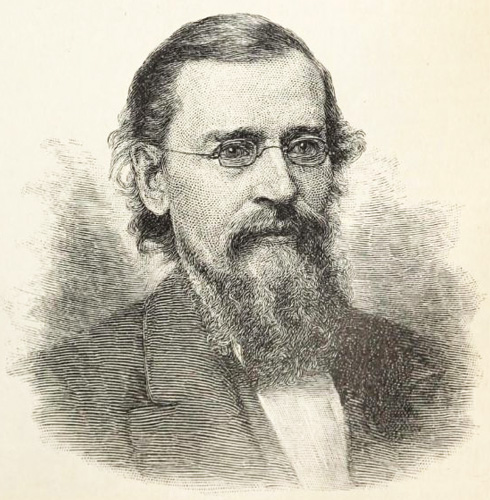
John Foster Kirk, editor Lippincott’s
Kirk promoted Lanier’s reputation as a significant up-and-coming poet by publishing his new works in the prestigious monthly magazine.
An enthusiastic amateur scholar, Lanier loved old European literature. While living in Baltimore as a professional musician, he made money lecturing about famous authors and their works at the prestigious Peabody Institute, at private secondary schools, and for paid “parlor study” events in homes of wealthy women. At one of these Daniel Coit Gilman, recently-named president of new Johns Hopkins University, witnessed Lanier delivering such a lecture intelligently and gracefully. Although he had no formal academic credentials beyond a degree (at age 18) from a small Georgia college, sage Gilman decided to invite Lanier to join his faculty as Lecturer in English. This very welcome chance in 1879 came at a time when Sidney couldn’t find decent employment anywhere else. He would have settled for any government job with a steady salary, and he had only minor paid publishing assignments to work on. Gilman’s appointment was his lucky break. Intermittent but worsening health was impinging his ability to support his wife and three children. For the next two academic years Sidney Lanier happily took on Johns Hopkins teaching; his position made it possible for Charles Scribner & Sons in New York to publish The Science of English Verse in 1880. Their academic title was well-received by most culture critics and academics, earning modest royalties and the opportunity to pitch more literature titles to Scribner’s.
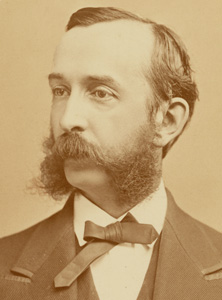
Daniel Coit Gilman, innovative American educator
National Portrait Gallery
Passed over for the presidency of Yale, Gilman was president at University of California, Berkeley, before accepting Quaker philanthropist Johns Hopkins’ invitation to establish the new university at Baltimore.
While lecturing at Johns Hopkins University, concurrently Lanier continued teaching younger students. His instruction at The Misses Adamses' School prepared ambitious young Baltimore women for university-level courses.
Tuberculosis has been a human scourge since ancient times, around the world. By some it was associated with artistic qualities, the “romantic disease.” Edgar Allan Poe, John Keats, Chekhov and Chopin were among famous creative personalities who suffered and died from it. (Yet today it’s estimated one-quarter of humans carry latent TB.) During the 19th century there was no cure. Treatment was a doctor’s guess. Various regimens and careful medical attention, even under best conditions, rarely halted progress of the “white plague.” Lanier’s own father, a respected Georgia attorney, didn’t believe a later, oft-repeated, claim that Sidney’s TB came about during Civil War confinement as a prisoner-of-war; Robert S. Lanier even suggested “consumption” ran in his wife’s family and he shared a common belief tuberculosis is a disease inherited. Sidney’s mother expired of “consumption” soon after Sidney returned home to Georgia after the war. The year after Lanier died in Polk County, North Carolina a German researcher discovered Mycobacterium tuberculosis, causative agent of the dreaded disease; not until the mid-20th century were vaccines devised to cure.
By the late 1870s Lanier’s health declined drastically. He had to give up flute performance. He coughed more and more. He was weak and lost appetite, typical signs of advancing TB. While teaching at Johns Hopkins he had to sit to deliver lectures, to the point that standing up even once to write something on a blackboard was too exhausting. During a trip to his New York City publisher Sidney consulted Dr. Alfred L. Loomis, specialist in diseases of lungs and heart. Loomis himself suffered from “consumption” and was involved with establishing sanitaria in rural New York. By the spring of 1881 as Lanier’s worsening condition reached crisis, Loomis counseled immediate and drastic methods. He advised relocation to high altitude for the “fresh air” regimen.
Mary Day Lanier, Sidney’s wife, went with him to New York and she agreed readily to Loomis’ regimen. They arranged for three sons to spend the summer with friends in Virginia, taking only infant Robin along to high-altitude Asheville, linked by rail the previous year to the Northeast. Departing Baltimore they met with Gilman who was shocked at Sidney’s haggard appearance. Lanier valiantly averred he’d beat his disease in the Appalachian mountains, claiming to Gilman he was contracted to write a profitable travel book about the Carolinas, as earlier he’d authored several imaginative Florida travel works for the Lippincott firm. In fact that commission already had vanished into thin air; even if he’d gotten it Lanier was in no physical condition to traipse around North and South Carolina to author it.
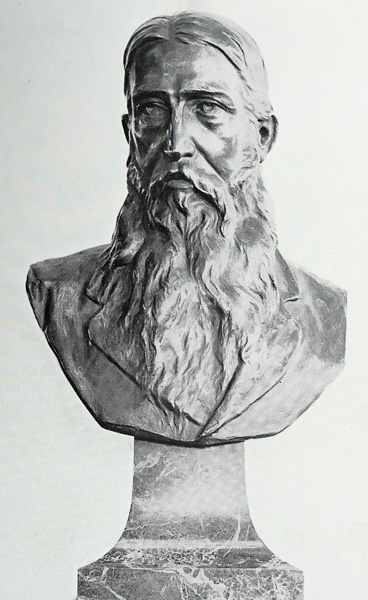
Portrait bust by artist Ephraim Keyser, executed several months before Sidney Lanier departed Baltimore alive, depicts the writer gravely aged beyond his years. Later, Keyser sculpted busts of Presidents Cleveland and Arthur, of Cardinal Gibbons, and of General de Kalb now at Annapolis.
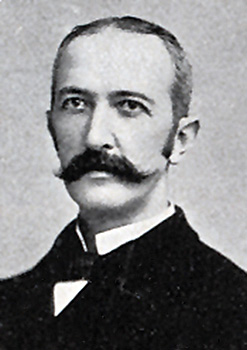
Richmond Pearson, Jr. (1852 – 1923) hosted the Laniers’ tent “Camp Robin” on his secluded Asheville estate. A Princeton graduate and lawyer, he served in North Carolina’s legislature and two terms in Congress representing its mountain district as a Republican. Pearson was an American consul in Belgium and Italy, and ambassador to Persia, Greece and Montenegro.
In 1871 at Asheville the nation’s first sanitarium opened devoted exclusively to TB. Very soon its vicinity became a go-to place for tuberculars. Always optimistic, Sidney addressed his dire health challenge with enthusiasm. Based at the Eagle hotel near Pack Square, he and Mary made plans for summer camping outside the city in a tent outfitted with a second-hand wood cookstove. Their site “Camp Robin” high above French Broad River was on the summer estate of recently-deceased Richmond M. Pearson, law teacher and chief justice of North Carolina. Sidney’s father, a prominent lawyer, and Mary’s father Charles Day, a wealthy entrepreneur, supported their Asheville plan. Judge Pearson’s son, also named Richmond, had served as United States consul in Belgium by appointment of President Grant – before whom Sidney Lanier’s Centennial cantata had been performed at Philadelphia, when its author was invited to sit in the President’s box. Pearson Junior had returned to North Carolina in 1878 upon his father’s death; he graciously granted the Laniers stabling privileges at his country estate and assistance by its staff. A pony cart was procured for transport into Asheville, a pony, and a riding horse for Sidney to take recreational rides. The relentless progression of his terminal illness, however, led to Lanier’s mounting the horse only twice.
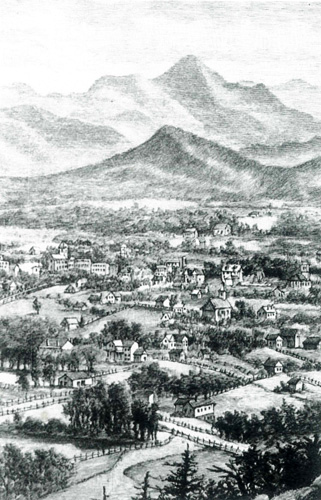
Asheville N.C. in 1881
Mary’s father, a widower who had lived with the Laniers in Baltimore, procured accommodation at elegant new Swannanoa hotel in downtown Asheville. Meanwhile Sidney’s father departed for Atlanta to attend to urgent matters. So Mary with hope invited Clifford, Sidney’s supportive younger brother in Alabama, to join them in their tent with wife “Wilsie.” Clifford was willing but Wilhelmina was not. Thus Sidney, Mary and their baby spent June 1881 desperate to achieve the “fresh air” cure at Camp Robin as the situation worsened. Sidney, in great pain, could barely move or sleep for days at a time. Letters arrived regularly from Scribner’s about Sidney’s latest book The Boy’s Mabinogion scheduled for release in autumn. Per contract they required Lanier to write an interpretive introduction and to copy-edit galley proofs coming off the printer’s press in Boston. In his wretched condition, living in the tent, writing and editing proved almost impossible.
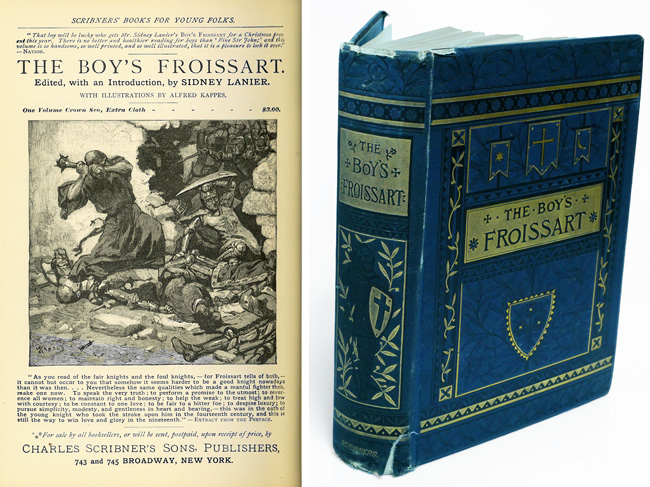
Mabinogion was third in a series of high-quality literature titles commissioned by Scribner’s. Lanier’s first volume came out in 1879 and established his national reputation, The Boy’s Froissart: being Sir John Froissart’s Chronicles of Adventure, Battle and Custom about the Middle Ages. Illustrated handsomely by New York artist Alfred Kappes and priced at three dollars per copy, it got rave reviews and made good profit for Scribner’s. Sidney was rightly proud of it, for he craved approval as a serious author and expert on historical literature. And he wished to demonstrate modern children’s literature could be on a higher plane than the “penny dreadfuls” and formulaic plots of most American books targeting young readers.
Second in the Scribner series came The Boy’s King Arthur: being Sir Thomas Malory’s History of King Arthur and his Knights of the Round Table. It’s Sidney Lanier’s abridged narrative of legends originally written by obscure English writer Thomas Malory in the 1400s. This 1880 title solidified Lanier’s reputation. It was Scribner’s block-buster Lanier title for many decades. Also illustrated by Kappes, in black & white, the New York publisher extended its long run brilliantly in 1917 by commissioning famous American artist N.C. Wyeth to create entirely new full color illustrations. In 1950 Vienna-born artist Florian Kraner did fresh illustrations for yet another well-regarded edition. It extended the author’s popularity into the later 20th century. Of all Lanier’s legacies, The Boy’s King Arthur undoubtedly has outsold all his other literature. Unfortunately for him and his family, in 1880 sick Sidney Lanier was strapped for cash. So he gave up its copyright to Scribner’s for a modest sum.
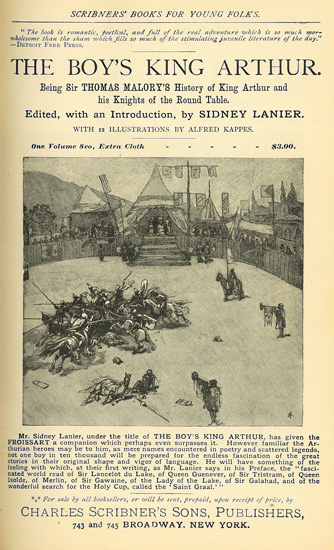
Scribner’s advertisement for 1880 first edition
with an illustration by Alfred Kappes
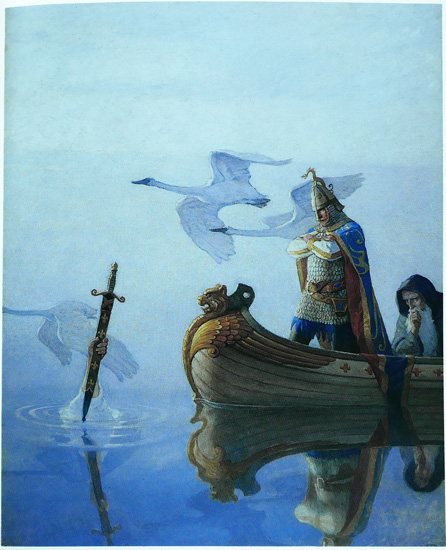
An artwork by American artist N.C. Wyeth
for Scribner’s 1917 edition
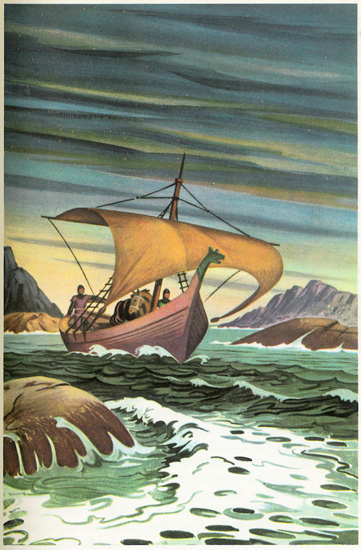
1950 King Arthur and His Knights of the Round Table
an illustration by Florian Kraner
Thus young and savvy Charles Scribner, not long out of Princeton and battling stiff competition in the book market, commissioned in early 1881 The Boy’s Mabinogion: being Earliest Welsh Tales of King Arthur. Far less known in America than Malory, these Arthurian tales originally were written down in (Celtic) Welsh; they are more “foreign” in tone with different characters and unfamiliar situations. Earlier during the 19th century they were first translated into English by scholar Charlotte Guest and published in Britain, in both (very different) languages. Another edition, in English only, appeared in Great Britain in 1877 with perfunctory illustration, where it was only a modest commercial success. As Lanier read no Welsh, that edition was what he used to edit his new book for America. Scribner spotted opportunity. Not only could Lanier’s work sell another title, his publisher had the momentum of The Boy’s King Arthur to sell prior book-buyers hungry for more Arthur. The marketing problem, however, was illustration — always important in selling books for juveniles. Mayhem, knights in armor, and tableaux of scenes at Court can get stale. Charles Scribner and his bright new literary editor Edward Burlingame made their important decision to drop capable Kappes and to go with a fresh artist for Mabinogion.
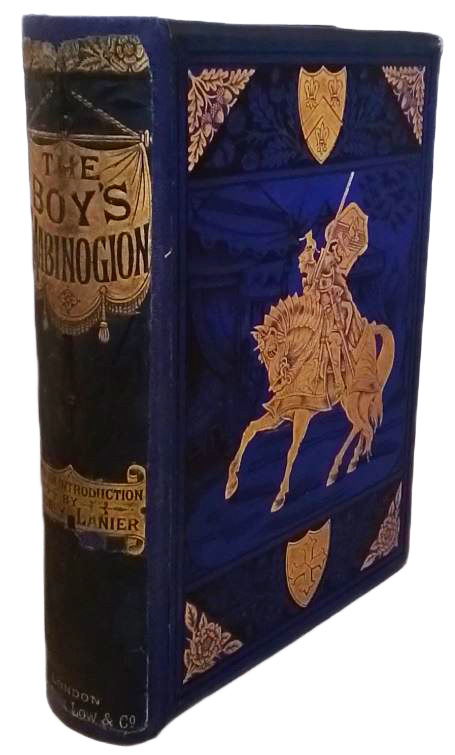
Binding for the British edition of Lanier’s Mabinogion
Their choice was Alfred Fredericks, a lion among New York artists during that era. Elected into the National Academy of Design while still in his twenties, British-born Fredericks was famed for his remarkably creative takes on illustration opportunities. He didn’t work cheap and he took on only interesting art assignments. He’d earned fame for successful books from Scribner’s leading competitors such as Harper’s and Appleton’s. Fredericks illustrated poetry by Sidney’s influential mentor Bayard Taylor, who recited his National Ode at the 1876 Centennial in Philadelphia for Fourth of July, to national acclaim. Negotiations with Fredericks took some time during early 1881, but Scribner was willing to pay the price. The illustrator went to work on twelve artworks. There can be little doubt Fredericks was paid much more than Lanier for creative work on Mabinogion. From surviving correspondence with Scribner’s, we sense Lanier realized this. It went without saying.
Already deep in debt to Scribner’s for advances, down in the North Carolina mountains Sidney Lanier managed during June to complete his scholarly introduction for it, laboring while gravely ill at Camp Robin. This turned out to be his very last literary effort intended to be published. It concludes:
“In now leaving this beautiful book with my young countrymen, I find myself so sure of its charm as to feel no hesitation in taking authority to unite the earnest expression of their gratitude with that of my own to Lady Charlotte Guest, whose talents and scholarship have made these delights possible; and I can wish my young readers few pleasures of finer quality than that surprised sense of a whole new world of possession which came with my first reading of these Mabinogion, and made me remember Keats’s
‘. . .watcher of the skies
When a new planet swims into his ken.’”
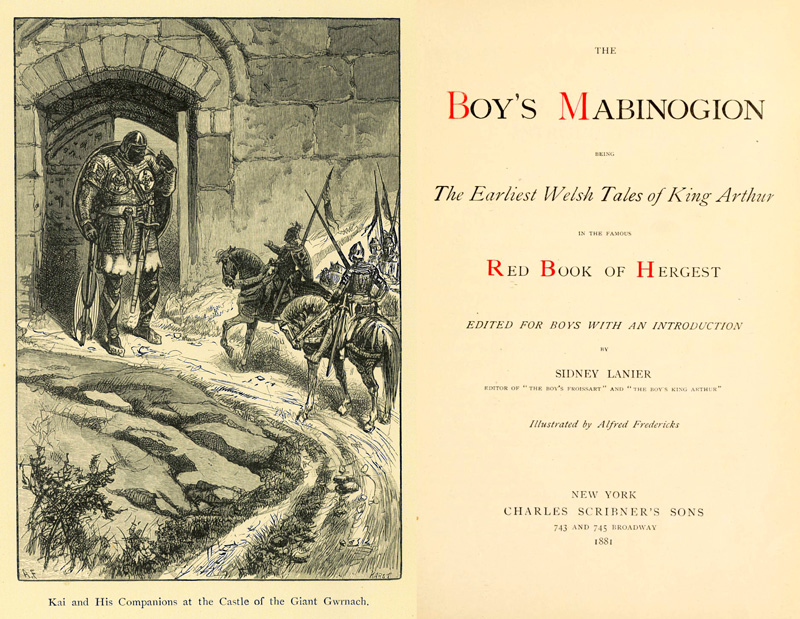
The book’s frontispiece illustration depicts the mythic giant Gwrnach. King Arthur’s men break into his castle and behead him to take his magic sword.
Fredericks’ dozen illustrations are quite different from Kappes’ more-literal drawings for Lanier’s two earlier Boy’s books. Elegant, luminous, Fredericks’ evoke a magic past. They contrast in a very interesting way with the violence and strange sensuality of Mabinogion’s ancient tales. And they completely outclassed the weak artworks of the 1877 edition in Great Britain. Scribner arranged a deal for his new edition to be produced in London for the British market. Its beautiful binding is handsome. Their American binding has a fresh, clean design superior to binding designs for Froissart and King Arthur fussily Victorian by comparison. Reprinted by Scribner’s as late as 1932, the first-rate Alfred Fredericks images of 1881 for Mabinogion remained appealing to book buyers well into the 20th century.
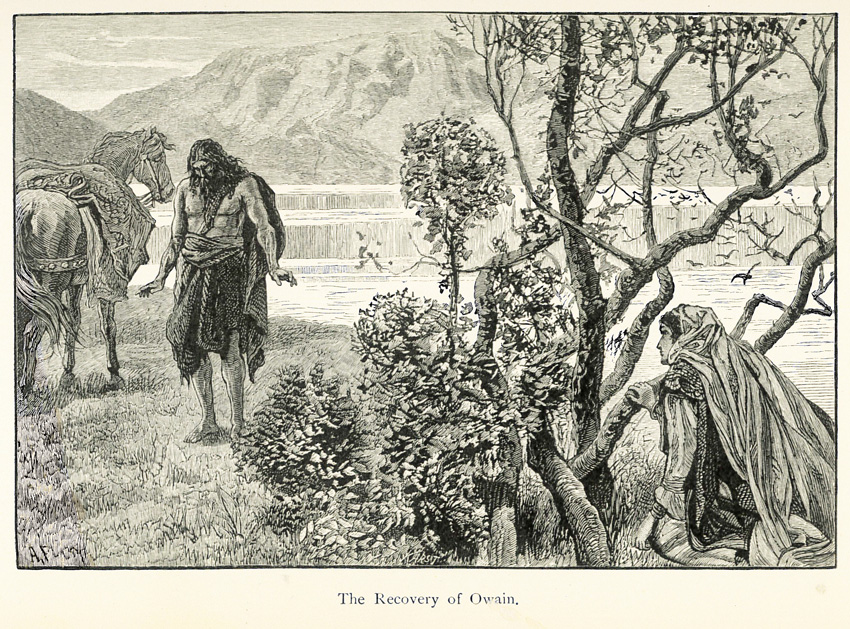
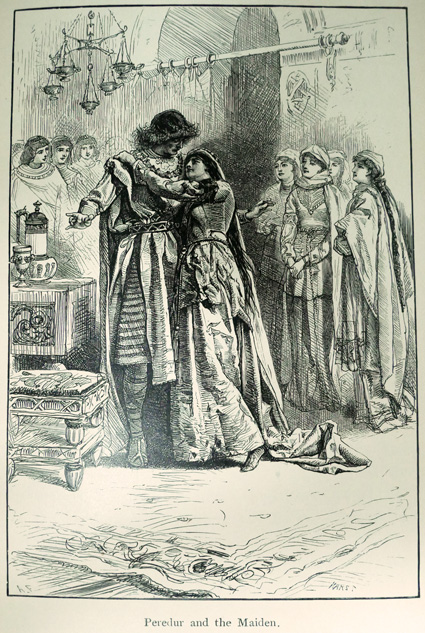
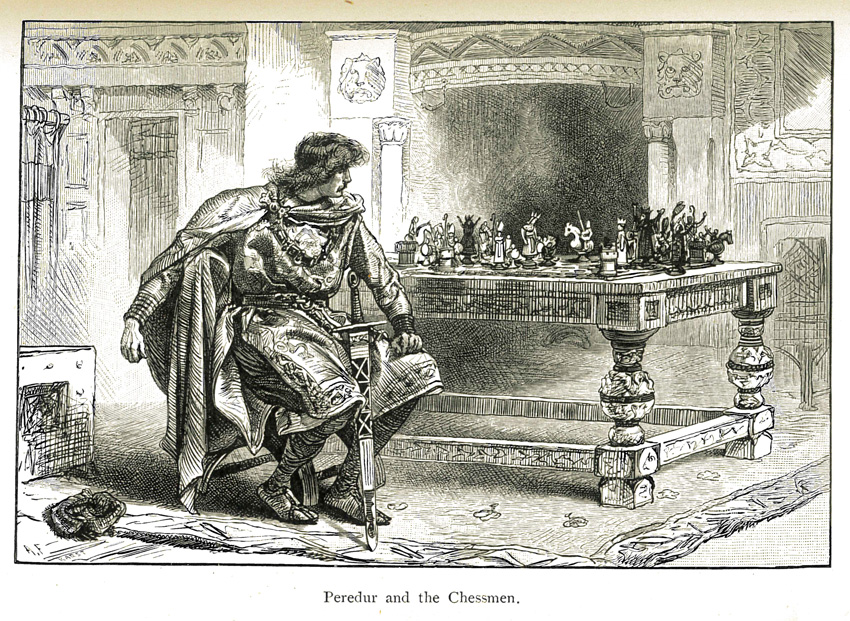
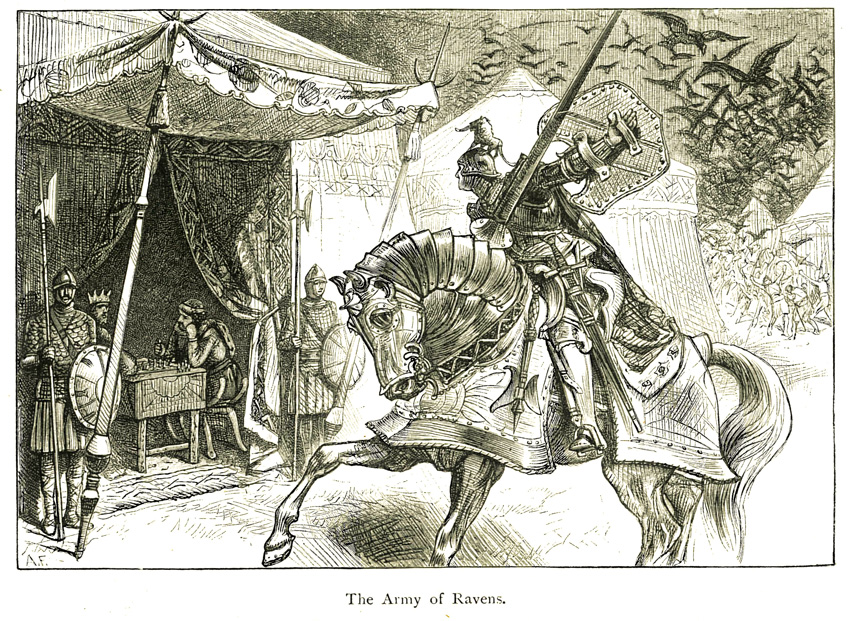
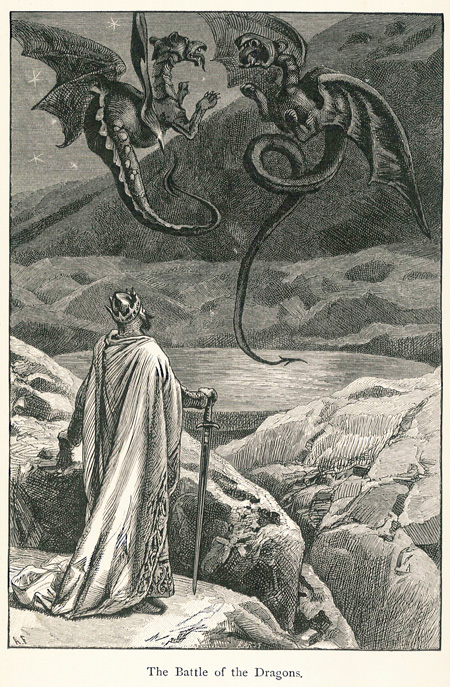
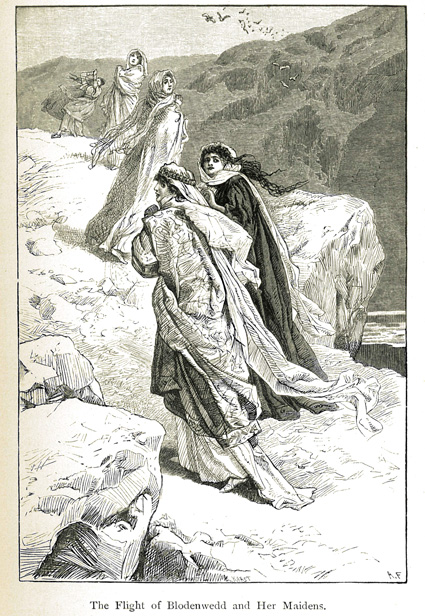
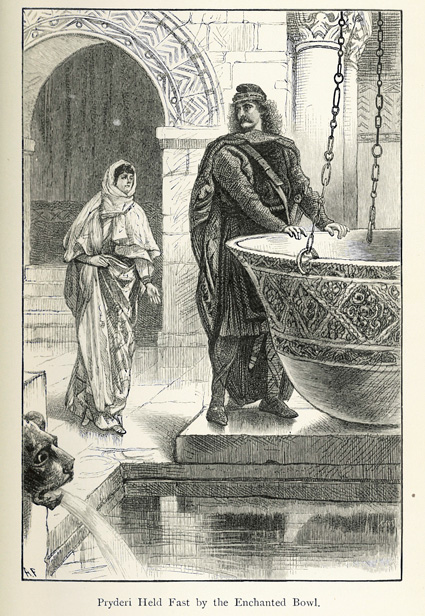
Scroll here to view some of Fredericks’ 1881 designs
and the old Welsh tales they illustrate.
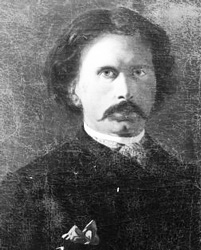
Alfred Fredericks (1835 – 1907)
illustrator of Lanier’s The Boy’s Mabinogion
While encamped at Asheville, Lanier’s surviving letters written from there tell us he already knew something about Tryon, located a thousand feet lower altitude some forty miles away to the south. Sidney had heard about the “thermal belt,” a purported no-frost belt on the sunny south escarpment of steep Tryon Mountain. Trained in the law and respectful of science, he wanted to know whether such a zone there could be affirmed by empirical evidence. He sent off to Johns Hopkins University a request for accurate thermometers and hygrometers to arrange objective measurements. Pairs of identical instruments could, he thought, be deployed by observers for readings inside and, simultaneously, outside the “zone.”

The original front cover for American edition of Mabinogion
By July it was obvious Dr. Loomis’ “fresh air” cure wasn’t working. Sidney couldn’t work, sleep or eat. In desperation it was decided to abandon the tent and to depart Asheville. He and Mary managed to make a day trip over to Waynesville area, to the west in Haywood county. They discovered there no advantage, and made a decision to migrate to Tryon Mountain in early August. There they checked in at McAboy’s, the private hotel at elevation a thousand feet lower than Asheville, built before the Civil War by a departed slaveowner. Already in 1881 it attracted cosmopolitan guests seeking simple quiet and comforts, and clean air. Though McAboy’s had railroad service from the nearby village called Tryon City, there was no rail connection yet with Asheville. They made the journey in one long early-August day, traveling primitive roads southeast to remote Polk County.
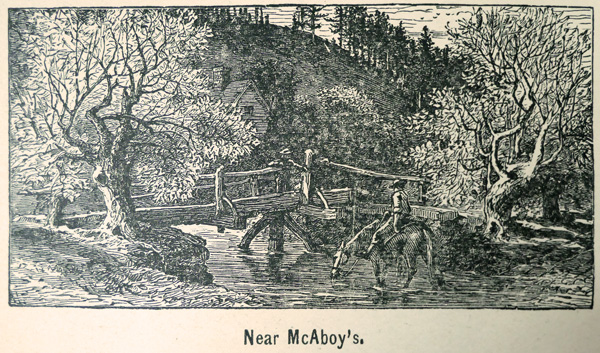
Popular Health Resorts of the South Chapin & Co. 1886
Sidney Lanier’s last letter, written from McAboy’s to Scribner’s in New York,
concludes:
“I shall pull through the present crisis and write many another book, whereof the germs have already been born in this strange and beautiful Tryon Valley.”
Sidney’s grandfather Sterling Lanier was born in hilly Rockingham county, North Carolina; in 1817 he came to Georgia where he established Macon’s first decent hotel. During the 1850s Sterling became manager, then owner, of a resort hotel at Montvale Springs in the Smoky Mountains of east Tennessee. Young Sidney stayed there, summers during his youth, and loved it. The Civil War shut down Montvale’s business, but his postwar novel Tiger-Lilies includes semi-biographical accounts of Appalachian pleasures which, we suppose, Lanier hoped to re-experience in some way when he and Mary Day Lanier came to McAboy’s in their last-ditch attempt to save his life. Like the old Montvale hotel, McAboy’s was constructed during the 1850s, a simple but comfortable three story frame building, self-sufficient for provisions and a lot nicer than existing in a tent. The place was well-staffed and the proprietors’ daughter and son-in-law, Annie and Lemuel Wilcox, vacated their own simple cottage on the grounds so Sidney, Mary and Robin could have their privacy.
Right away, Mary’s letters report, they found rural Polk County to their liking. The scenery, the people, and McAboy’s casual atmosphere greatly appealed to them. She wrote confidentially to a lady friend in New York they only wished they’d come sooner. Nights were much less chilly than at Asheville. Clifford, always supportive, came to be around his brother and to provide moral support for Mary. From Charleston first-cousin Lanier Eason came up, too, on the train. For both young men August in the North Carolina mountains was, after all, not unattractive. Excursions to waterfalls, tramps in the forests and nice company were vacation for them.
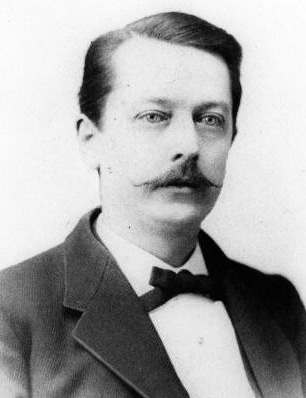
Clifford Lanier was close to his older brother Sidney. Together they served in the Confederacy’s marine signal corps, at Wilmington on the North Carolina coast, and after the War they even collaborated authoring “recreational” verses. Sidney went north to further his career in Pennsylvania, and later to Maryland, while Clifford settled in Montgomery, Alabama.
By the first of September, although Sidney himself professed his optimism, his courage could not convince his kin and his friends that he would survive another month. Johns Hopkins mailed a kind renewal of his university appointment as Lecturer in English, but nobody believed he would make it back to Baltimore. Clifford departed, helpless to help further but hoping for a miracle; a telegram summoned him back but it was too late.
Burlingame at Scribner’s graciously took on the onerous task of proofreading the rest of the galleys for Mabinogion so that publication on-time in October would happen. His diplomatic letter reassuring Sidney left New York on September 5, 1881 but it did not reach McAboy’s by the morning of the 7th when Sidney Lanier passed away in the Wilcox cottage.
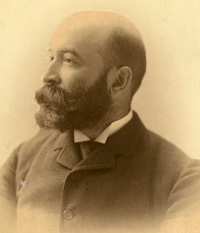
Edward Burlingame, Scribner’s literature editor and champion of Lanier’s work, went on to a distinguished career in American publishing.
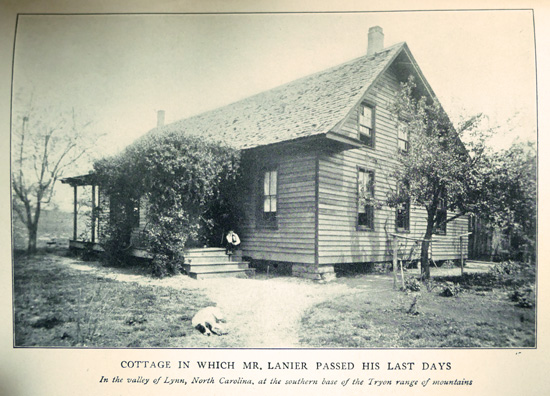
Wilcox 1870s wood cottage was enlarged and bricked-over some years ago. It’s private property not open to the public.
The writer’s body, Mary and the baby departed Tryon Depot on the next Southern Railway train for Baltimore. At 5 p.m. on September 9 a simple funeral there took place at St Michael and All Angels church. Quickly interred, no autopsy was performed as he had wished. We know now that autopsy techniques, then, could not have explained Sidney Lanier’s excruciating pain and his rapid decline.
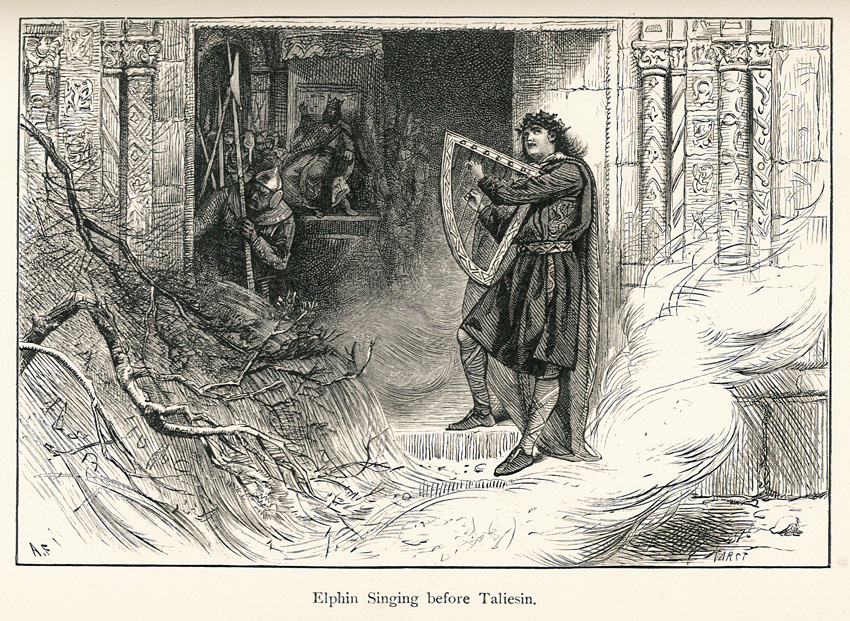
The Boy’s Mabinogion came to market on schedule. Alfred Fredericks’ beautiful concluding illustration depicts minstrel Elphin with his lyre singing for Taliesen, in the ancient Welsh story of that name. It’s poetical that Lanier’s interpretive note has this to tell: Taliesen is the greatest of Welsh poets, and is called by his countrymen ‘The Prince of Song.’ He became bard at the court of King Arthur, and was one of the brightest in that glorious assemblage. The actual man Taliesen appears to have lived in the sixth century, and poems remain which are believed to be his genuine works.
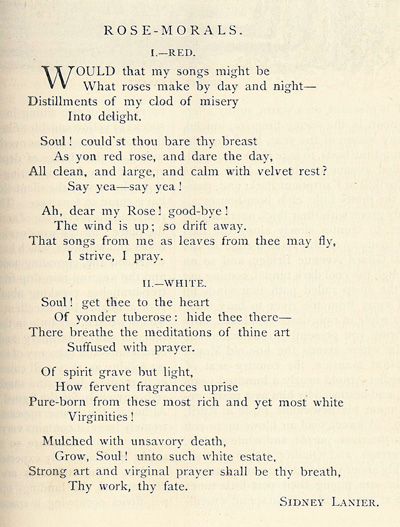
Most of the 164 poems Sidney Lanier wrote during his lifetime remained unpublished at his death. His widow Mary determined to honor her husband, and to provide for her children, by gathering all his verses and editing them. She presented this body of creative work to Scribner’s. They agreed to publish it in 1884, which sold well. They published posthumously, too, other work including The English Novel and the Principles of Its Development, a summation of his last university lecture course. In 1884 Charles Scribner’s Sons brought out a second edition of Mabinogion with new fore title Knightly Legends of Wales in a stately new binding. In bright gold the volume reads Knightly Legends on its spine; the book retained that title ever after.
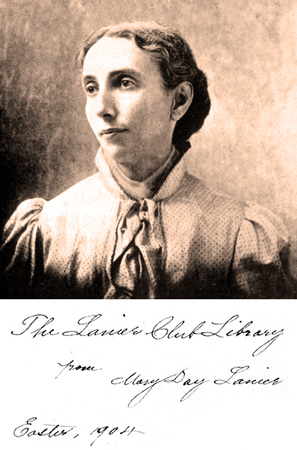
Mary Day Lanier lived her youth in Macon, Georgia and later in New York City. Musical and broad-minded, she enjoyed the company of unconventional persons and her closest friends resided in the North. Mrs Lanier wasn’t intimidated by big-city publishers; her negotiations with them often were more successful than her genial husband’s.
Mary Day Lanier returned to Tryon with Robin (Robert) and Sidney Lanier, junior, to live at a house on what’s now quiet Lanier Street. They attended Holy Cross Episcopal nearby. Sidney played flute in the little Tryon Orchestra and took up grape-growing, partnering with Harold Doubleday whose father Ulysses had served as general in the Union Army. Sidney married a Canadian woman and died at their Camp Sidney Lanier, a summer camp for boys and girls in Eliot, Maine. Her son Henry at 21 got a job in Manhattan with Scribner, in 1894. Among Henry’s editing assignments he helped them bring out Music and Poetry: Essays from Some Aspects and Inter-Relations of the Two Arts, a book of lectures his father wrote while Henry was a school-boy. (Henry Wysham Lanier was named after Henry Wysham, his parents’ Baltimore friend, lawyer and keen amateur flute player.) Oldest son Charley graduated from Johns Hopkins in 1889; he excelled at baseball and tennis, a keen quail hunter and handler of bird dogs by the time he was 17. Charles began work in Wall Street, was a banker and mining company president, and became assistant editor of Cosmopolitan magazine. He published American Review of Reviews monthly periodical about the era’s trans-Atlantic culture of progressive reform.
In 1890 Tryon women from the North and from the South decided to form a serious club for literary study, education about world affairs, and general betterment of their community. They asked Mary whether she’d endorse calling it The Lanier Club. She agreed and presented volumes of her husband’s writings to initiate a village lending library. Among those were Scribner editions of literature for boys. All the club’s books were later lost in a disastrous fire, as too their plaster copy of a fine bronze portrait bust of Sidney Lanier sculpted during his life in Baltimore. Nevertheless another plaster replica was procured, yet today displayed in The Lanier Library.

Binding for 1897 edition of Lanier poems features clover image. His 1876 poem Clover is dedicated to John Keats, English poet who died at 25 of tuberculosis.
Mary Day Lanier’s collection for Scribner’s 1884 volume begins with three major poems not published before Lanier’s death. She edited them for three important American magazines to publish in 1882. His Sunrise came out in The Independent, a prestigious New York publication which earlier had brought out new work by such famous authors as Whittier, Elizabeth Barrett Browning, and Harriet Beecher Stowe. She reveals Sidney wrote in early 1881, while very sick in Baltimore, at least three poems shorter than these. Thus it’s myth Sunrise was Lanier’s last poem or that he wrote it in North Carolina. Mary considered it his finest poem and presented it first in the collection. Written 1880 in Maryland, in classical logaoedic meter, Sunrise concludes:
. . . I am lit with the sun.
Oh, never the mast-high run of the seas
Of traffic shall hide thee,
Never the hell-colored smoke of the factories
Hide thee,
Never the reek of the time’s fen-politics
Hide thee,
And ever my heart through the night shall with knowledge
abide thee,
And ever by day shall my spirit, as one that hath tried thee,
Labor, at leisure, in art, — till yonder beside thee
My soul shall float, friend Sun,
The day being done.
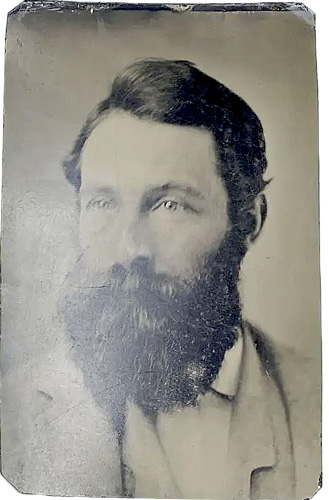
courtesy Tom Lecky, Riverrun Books & Manuscripts

Questions or comments? Get in touch:
TryonHistory.org publishes original essays pertaining to Polk County, North Carolina before 1999. We’re not a history museum or archive, and we don’t conduct historical research for individuals or organizations.
-
111 Kangaroo Drive
Columbus, NC 28722
- (828) 436-2102
- info@tryonhistory.org
- © Condar Press. All rights reserved.